Onderwerp
Cybersecurity
Beveiligingstermen die elk bedrijf moet kennen: phishing, ransomware, versleuteling, tweestapsverificatie, zero trust, back-ups en de gewoontes die data en accounts veilig houden.
35 begrippen in dit onderwerp
Cybersecurity
T
Two-Factor Authentication 2FA Two-factor authentication is a sign-in that asks for your password and then for something you are holding, so a stolen password alone is not enough to get in. Lees de uitleg
P
Phishing Phishing is a message built to look like it came from someone you trust, so that you hand over a password, a code or a payment. Lees de uitleg Password Manager A password manager is a small program that remembers every password for you and keeps them locked away, leaving you just one to memorise. Lees de uitleg
A
Authenticator App An authenticator app is a free app on your phone that produces the six-digit code a website asks for after your password, so a stolen password is not enough. Lees de uitleg
S
SIM Swap Fraud SIM swap fraud is a scam in which a criminal moves your phone number onto their own SIM card, so your calls and security codes reach them instead. Lees de uitleg Social Engineering Social engineering is an attack on the person rather than the computer, where someone uses fear or hurry to talk you into handing over a code or a payment. Lees de uitleg
I
Invoice Fraud Invoice fraud is a fake or altered supplier bill that gets you to pay a real amount into a bank account the criminal controls. Lees de uitleg
Q
QR Code Phishing (Quishing) QR code phishing, also called quishing, is a scam where a fake code is stuck over a real one so your phone opens a fake payment page. Lees de uitleg
S
Security Awareness Training Security awareness training is the short, regular practice that teaches your staff to spot a fake email or phone call before they act on it. Lees de uitleg
M
Malware Malware is any program written to damage your computer or to work quietly for someone else while you carry on using it. Lees de uitleg
R
Ransomware Ransomware is a program that locks every file on a company's computers and then demands a payment before it will hand them back. Lees de uitleg
K
Keylogger A keylogger is a hidden program that records every key someone types on a computer, including the password to the company bank account. Lees de uitleg
B
Backup A backup is a second copy of your files, kept somewhere safe from whatever destroys the first copy, so you can get your work back. Lees de uitleg
D
Disaster Recovery Plan DRP A disaster recovery plan is a short written document that says exactly what your business does, and who does it, on the morning the systems stop working. Lees de uitleg
L
Least Privilege Least privilege means each person can open only the screens their own job needs, so a stolen account cannot reach the rest of the business. Lees de uitleg
U
User Access Review A user access review is a regular check of who can still log into your systems, including the accounts nobody remembers creating. Lees de uitleg
O
Offboarding Offboarding is the security work a business does when someone leaves, closing every login and shared password they had so nothing stays open behind them. Lees de uitleg
Z
Zero Trust Zero trust is a way of working where nobody is trusted just for sitting inside the office, and every single login is checked again. Lees de uitleg
P
Patch Management Patch management is the habit of updating every program and device you use on a set plan instead of whenever someone remembers. Lees de uitleg
E
End-of-Life Software EOL End-of-life software is a program its maker has stopped repairing, so any weakness someone finds in it from that day on stays open forever. Lees de uitleg Ethical Hacking Ethical hacking is an attack on your own system that you asked for and paid for, so a trusted expert finds the holes before a criminal does. Lees de uitleg
W
Web Application Firewall WAF A web application firewall is a filter that reads every request arriving at your website and blocks the ones that look like a known attack. Lees de uitleg
O
OWASP Top 10 The OWASP Top 10 is a free list of the ten mistakes that most often let a stranger into a website or a web application. Lees de uitleg
J
Jailbroken Device A jailbroken device is a phone whose built-in protections have been removed on purpose, which lets one app read what another app keeps private. Lees de uitleg
T
Third-Party Risk Third-party risk is the chance that your data leaks through a supplier, a freelancer or a plugin you trusted, rather than through your own team. Lees de uitleg
E
Encryption Encryption is a way of scrambling your information into nonsense, so that only the person holding the right key can read it again. Lees de uitleg
H
HTTPS HTTPS is the protected version of a web address, and it scrambles everything sent between a visitor's browser and your site so nobody in between can read it. Lees de uitleg
P
PCI Compliance PCI DSS PCI compliance is the set of safety rules that the card companies make every business follow before it is allowed to take card payments. Lees de uitleg
D
Data Breach A data breach is the moment private customer information leaves your control, whether a thief took it or someone simply sent it to the wrong address. Lees de uitleg
C
Cyber Insurance Cyber insurance is a policy that pays for the clean-up after an attack, as long as you kept the security promises you made on the application form. Lees de uitleg
G
GDPR GDPR GDPR is the European law that sets out how a business may collect, keep and use the personal information of the people it serves. Lees de uitleg
V
Vulnerability Scan A vulnerability scan is an automatic check that searches a website or an app for weaknesses attackers already know about and reports what it finds. Lees de uitleg Virtual Private Network VPN A virtual private network is a sealed tunnel through a public connection, so what your staff send on café or hotel wifi cannot be read by anyone nearby. Lees de uitleg
Z
Zero-Day Vulnerability A zero-day vulnerability is a hole in software that has just been found and has no fix yet, so everyone using that part is exposed until one arrives. Lees de uitleg
S
SQL-injectie SQLi Een aanval op websites waarbij iemand databaseopdrachten in een formulier of webadres typt. De website voert ze uit en laat zo gegevens zien, wijzigt of wist ze, terwijl ze die juist moet beschermen. Lees de uitleg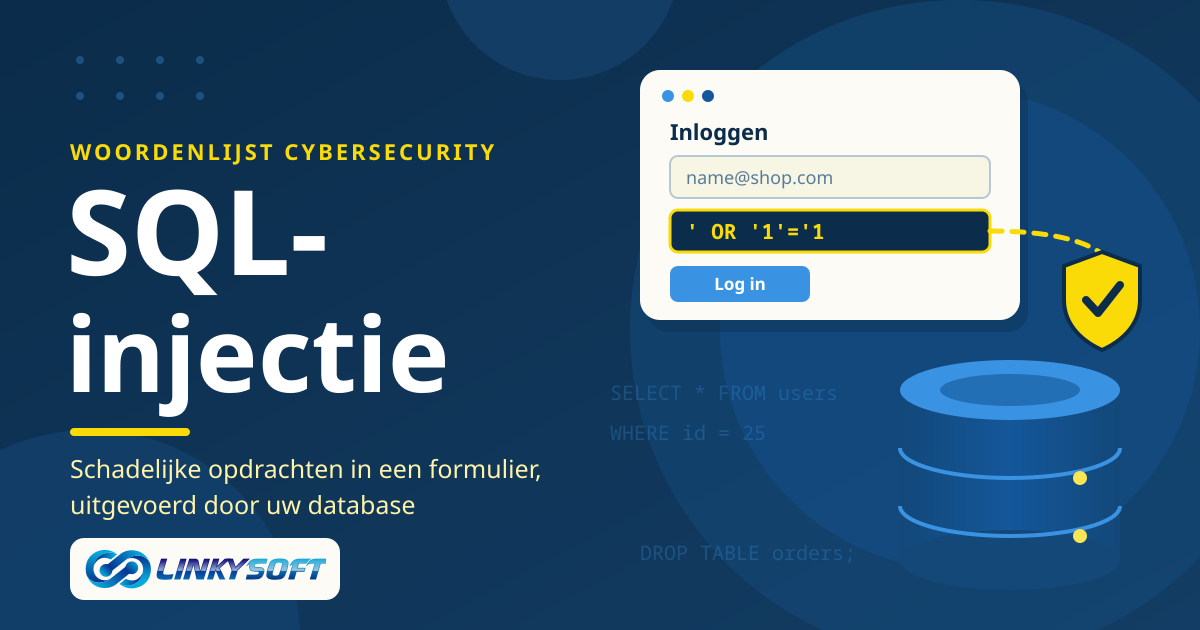
Andere onderwerpen
Webhosting Heldere uitleg van de webhostingtermen die je tegenkomt als je een website online zet: uptime, service level agreements, opslag, SSL en de onderdelen van een hostingpakket die bepalen hoe snel en betrouwbaar een site is. 2 Servers Wat servers en de databases erop doen, in gewone taal: VPS en dedicated servers, MySQL, PostgreSQL, MongoDB, Redis en de termen die je nodig hebt als je je eigen server beheert. 4 Domeinnamen Domeinnamen eenvoudig gemaakt: registratie, DNS, nameservers, verlengingen, verhuizingen en de woorden die je nodig hebt om het adres van je website te kiezen, te koppelen en te beschermen. 0 E-commerce De taal van online verkopen: SKU's, productvarianten, verlaten winkelwagens, orders volgen, betalingen, kassasystemen en de cijfers die laten zien hoe een winkel er echt voor staat. 30 Cloud computing Cloud computing en de tools die software ernaartoe brengen: wat de cloud is, hoe Docker en Kubernetes applicaties draaien en hoe Git en CI/CD elke release veilig houden. 5 Social media Social media begrippen voor bedrijven: WhatsApp marketing, influencercampagnes, videoadvertenties en de woorden achter het laten groeien van een publiek en het spreken van klanten waar ze al zijn. 3 Websites De bouwstenen van een website in gewone taal: HTML, CSS, responsive design, rechts-naar-links lay-outs en het verschil tussen een website en een webapplicatie. 6 Webapplicaties Termen die je tegenkomt als een bedrijf een webapplicatie bouwt of koopt: API's, dashboards, gebruikersrollen, single sign-on, deployment, schaalbaarheid en de kosten van software in eigendom. 29 Mobiele apps Begrippen rond mobiele apps uitgelegd: native en hybride apps, pushmeldingen, in-app aankopen, beoordeling in de app store, offline synchronisatie en wat een app actueel en veilig houdt. 25 Online marketing Online marketing begrippen uitgelegd: conversieratio, landingspagina's, salesfunnels, e-mailcampagnes, pay per click, attributie en de cijfers die laten zien wat echt werkt. 26 Kunstmatige intelligentie Kunstmatige intelligentie in gewone taal: machine learning, grote taalmodellen, chatbots en hoe bedrijven AI inzetten om klanten te antwoorden en dagelijks werk te automatiseren. 4 Internet of Things Internet of Things begrippen eenvoudig gemaakt: verbonden apparaten, sensoren, gateways en de woorden achter slimme gebouwen, tracking en machines die hun eigen status doorgeven. 0 Programmeertalen Korte, heldere uitleg van de programmeertalen achter de software van nu: Python, PHP, JavaScript, TypeScript, Java, Go, Rust, Kotlin, Swift, SQL en meer. 12 Frameworks De frameworks waarop ontwikkelaars bouwen, helder uitgelegd: Laravel, Django, React, Next.js, Node.js, Flutter en wat elk ervan aan een web- of mobiel project toevoegt. 6 Zoekmachines Zoekmachinetermen uitgelegd: SEO, indexering, sitemaps, canonieke URL's, featured snippets, zoekintentie en wat een website helpt om in Google en AI-antwoorden te verschijnen. 30 Gebruikersinterfaces Begrippen rond interface en gebruikerservaring: prototypes, user experience, donkere modus en de ontwerpkeuzes die software en websites makkelijk en prettig in gebruik maken. 3