

Blog

Real Estate & Rental Management

Managing units, owners, tenants and rent collection without a spreadsheet: what property software should do for brokers, developers and landlords, and where most of it falls short.

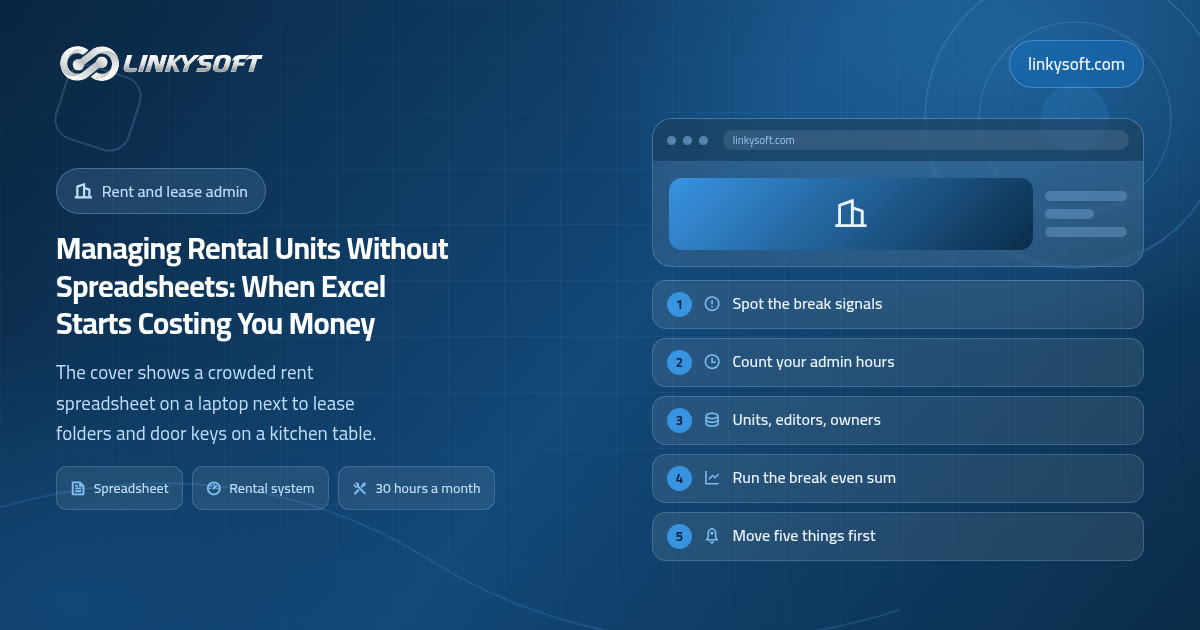
Managing Rental Units Without Spreadsheets: When Excel Starts Costing You Money

Nearly every article on this subject tells you to buy software in the first paragraph. This one does the opposite: it gives you the actual break points in units, editors and hours, the arithmetic to price your own situation on a calculator, the costs that hide inside an ordinary working week, and a plain statement of when keeping the spreadsheet is still the correct business decision.

1 minute read

Questions about this topic

Quick, clear answers to what readers ask most about this topic.

What is real estate management software?

Real estate management software is a system that keeps a property business's units, owners, tenants, contracts and payments in one place. Real estate management software replaces scattered spreadsheets, paper files and notebooks. Brokers, developers and landlords use it to see the status of every unit and every payment at a glance.

What is the difference between property management software and rental management software?

Property management software covers the whole life of a property, while rental management software focuses on leases, tenants and rent collection. Many systems do both, with rental features as one part of a wider property system. Developers and brokers who also sell units usually need the wider property management scope.

Why should a landlord stop using spreadsheets to manage rentals?

A landlord should stop using spreadsheets for rentals because spreadsheets do not send reminders, track due dates or link a payment to its contract. Mistakes and lost files grow quickly as the number of units rises. Rental management software keeps one record per unit and per tenant and flags late rent automatically.

What features should rental management software have?

Rental management software should have a register of units, lease contracts, automatic rent schedules, late payment alerts and tenant records. Owner statements, maintenance requests and basic accounting are also important. A tenant portal and lease expiry reminders save the team many phone calls.

How does property management software help with rent collection?

Property management software helps with rent collection by creating every instalment and due date from the lease contract. The system shows who has paid, who is late and by how many days. Automatic reminders and late alerts mean the team follows up on time instead of relying on memory.

What is a unit register in real estate software?

A unit register is the list in real estate software of every project, building, floor and unit a business manages, with each unit's details and status. The status shows whether a unit is vacant, reserved, leased or sold. A clear unit register answers the question of what is available in seconds.

How does real estate software handle lease renewals?

Real estate software handles lease renewals by tracking every lease end date and alerting the team before a lease expires. The team can then contact the tenant early, agree on new terms and create a renewal contract. Early alerts reduce empty months between tenants.

Can real estate software manage off-plan sales by instalment?

Yes, real estate software designed for developers can manage off-plan sales by creating an instalment plan from each sale contract. The system tracks every due date, each payment received and the balance still owed by each buyer. This gives the developer a clear view of expected collections across the whole project.

What is a tenant portal?

A tenant portal is an online page where tenants can see their lease, their payment history and what they owe. Many tenant portals also let tenants send maintenance requests. A tenant portal cuts down on calls and messages to the property team.

How does property management software track maintenance requests?

Property management software tracks maintenance requests by turning each request into a job with a unit, a description and an assigned person. The team can see which jobs are open, in progress or done. A history of jobs per unit also shows which units need the most attention.

How do real estate brokers use CRM features in property software?

Real estate brokers use CRM features to track leads, viewings and offers from the first enquiry to a signed contract. Each lead keeps its history, so any team member can continue the conversation. Brokers can also see which sources bring the most serious buyers and tenants.

What reports should real estate software provide?

Real estate software should provide reports on occupancy, rent collected and overdue, lease expiries, owner statements and income and expenses. Brokers also need reports on leads, viewings and closed deals. These reports help managers spot problems early and make decisions on facts.

How does real estate software calculate broker commission?

Real estate software calculates broker commission from the rules set on each sale or lease contract, such as a percentage of the deal value. The commission is recorded when the contract is created, so nobody has to calculate it by hand later. This keeps commission records consistent with the actual contracts.

Should property management software include accounting?

Yes, property management software works best when it includes accounting or connects tightly to an accounting system. When contracts create the accounting entries, the agreement and the ledger always match. Separate systems usually mean typing the same numbers twice and finding mistakes later.

Who needs rental management software?

Rental management software is needed by landlords with several units, property managers who manage units for owners and companies that lease commercial space. Even a small portfolio benefits once tracking due dates and contracts by hand becomes a burden. Larger portfolios usually cannot run reliably without one.

How long does it take to move a property business to new software?

Moving a property business to new software usually takes from a few days to a few weeks, depending on the number of units and how clean the existing data is. The main work is importing units, tenants and active contracts and training the team. Starting with the units and active leases first gets the business running quickly.

What data should I prepare before starting real estate management software?

Before starting real estate management software, prepare a list of your projects, buildings and units, your active contracts, your tenants and owners, and any balances still due. Clean, consistent data makes the import faster and avoids errors. Copies of contracts and key documents can be attached to each unit later.

Can real estate software send alerts for late rent?

Yes, good real estate software sends alerts for late rent as soon as an instalment passes its due date. The alert shows the tenant, the unit and the amount due, so the team can follow up the same day. Regular alerts reduce long overdue balances that are hard to collect.

Is cloud property management software safe for tenant data?

Cloud property management software can be safe for tenant data when the provider uses encryption, regular backups, strong passwords and user permissions. Each staff member should see only the data their job requires. Before choosing, ask the provider where the data is stored and how backups and access are handled.

What is the difference between ready-made and custom real estate software?

Ready-made real estate software is a finished product you can start using quickly, while custom real estate software is built around one company's own way of working. Ready-made software suits most brokers, landlords and developers with common workflows. Custom software suits companies with unusual processes or integrations that ready-made products do not cover.

How can property owners get statements from a property manager?

Property owners get statements from a property manager through property management software that records rent, expenses and fees per unit and per owner. The software produces a statement for each owner for any period. Some systems also let owners view their statements online at any time.

Can real estate software manage auctions?

Yes, some real estate software can manage auction contracts alongside lease and sale contracts. The system records the auction terms and then creates the payment schedule from the winning contract. This keeps auctioned units in the same register as the rest of the portfolio.

Where does most real estate software fall short?

Most real estate software falls short by keeping contracts and accounts apart, so staff type the same figures twice. Many systems also cover only rentals or only sales, which forces a business to use several tools. Weak reporting and no support for the local language are other common gaps.

What is Rolmaz?

Rolmaz is Linkysoft's real estate management system that holds every unit, contract and person attached to them in one place. Rolmaz covers projects, buildings, floors and units, lease, sale and auction contracts that create instalments and commission by themselves, tenant and owner records with a tenant portal, leads, maintenance and accounting. Rolmaz was designed with more than twenty real property businesses in mind.

Can I try Rolmaz before choosing it for my property business?

Yes, Rolmaz offers a 30-day free trial. Rolmaz is built for owners and investors, property managers, brokers and marketing teams, and developers selling off-plan by instalment. In Rolmaz the contract writes the accounts, so the agreement and the ledger always match.