Ask what a website costs and you will almost always be told that it depends, which is true and completely useless in the same breath. It depends on what, by how much, and where exactly does the money land? Those are answerable questions, so this page answers them with numbers instead of caveats.
Why the Same Website Gets Quoted at US$800 and at US$40,000
That spread is not evidence that somebody is trying to fleece you. It exists because the word "website" covers a one page profile with a phone number on it, a booking system that takes deposits at two in the morning, and a customer portal where four hundred clients log in to see their own records. Those are three different products that happen to share a name, so when the buyer says website and the seller hears platform, the two of them are pricing entirely different things and neither one realises it until the numbers arrive.
Strip away the jargon and any quote is really pricing three things. The first is how many hours of skilled work go in, because design, building, testing and setup are all somebody's working day. The second is how much of that work is made for you rather than reused from something that already exists, since a layout borrowed from a library costs a fraction of one drawn from nothing. The third is who carries the risk if something breaks two months after launch, which is the line nobody reads and the one that decides whether you pay for the same thing twice.
So here is what follows: honest bands with real ranges, a typical quote opened up line by line, the running costs that rarely appear in a proposal, and a plain statement of when spending less is the better decision. Every term gets explained the moment it turns up, because you should not need a technical background to buy a website any more than you need to be a mechanic to buy a van. The figures below come from Linkysoft's own quoting, and from the quotes we see from other firms when clients bring them to us for a second opinion.
The Five Price Bands, and What You Actually Get in Each
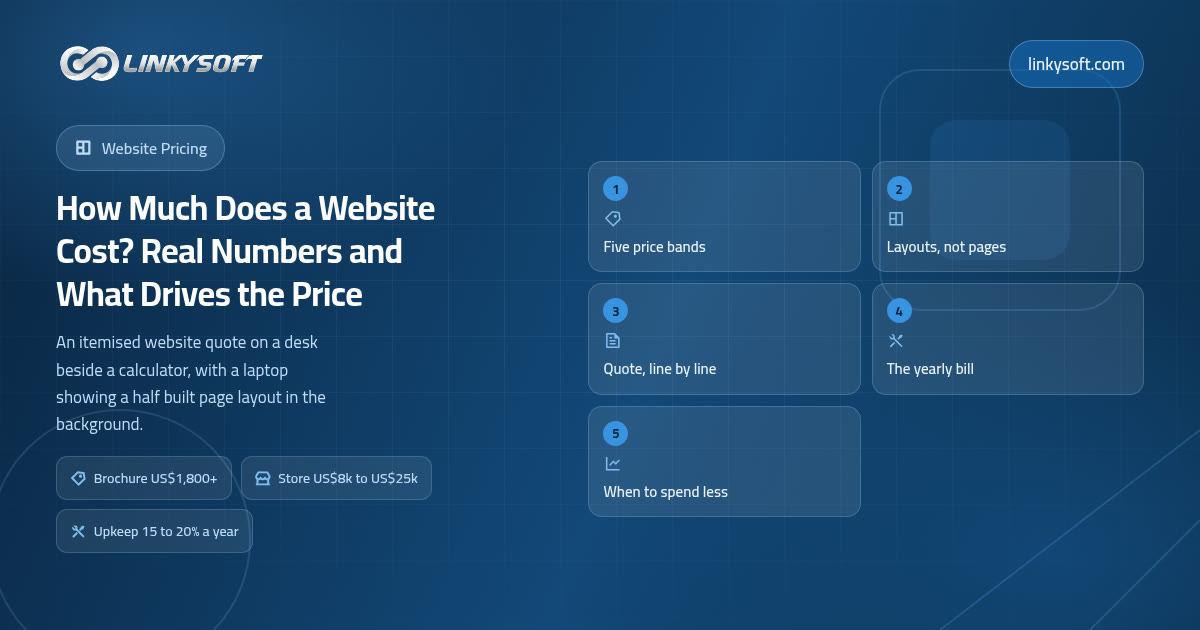
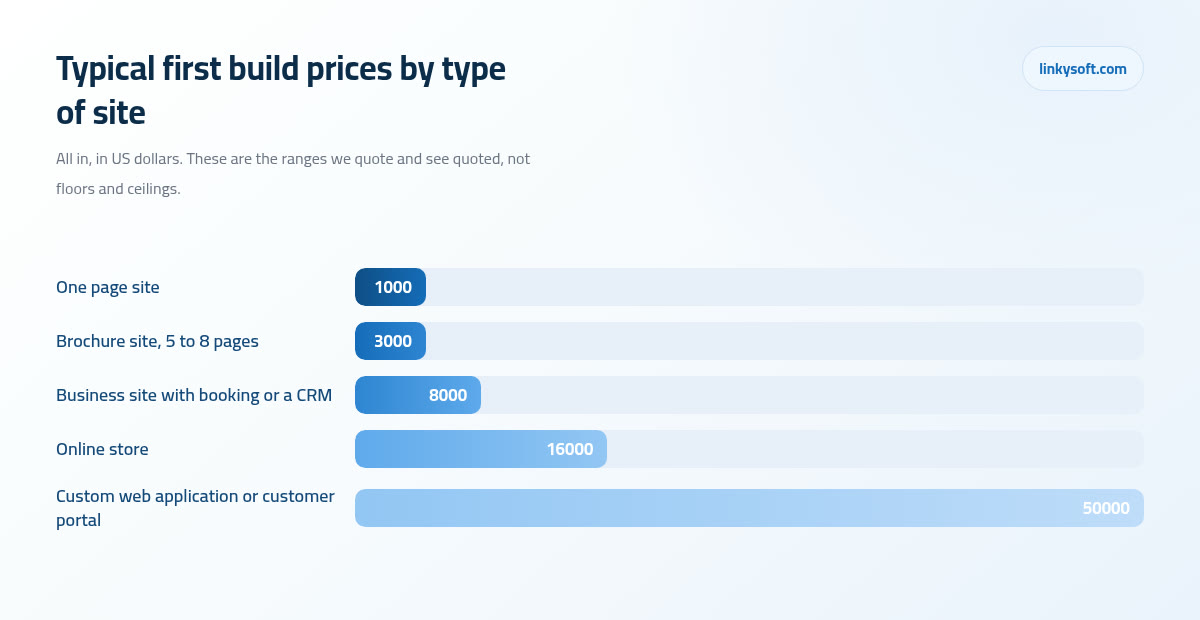
Almost every website lands in one of five bands. The ranges are all in first build prices, meaning design, building, setup and launch together, and the weeks beside them are calendar weeks from signature to going live.
- One page site: US$600 to US$1,500. Everything on a single scrolling page, live in one to two weeks. Right for a new venture that needs an address on the internet and a way of being contacted.
- Brochure site of five to eight pages: US$1,800 to US$4,500. Home, services, about, contact and perhaps a blog, in three to six weeks. This is where most small businesses genuinely belong.
- Business site with booking, two languages or a CRM link: US$5,000 to US$12,000. Six to ten weeks. A CRM is simply the software that holds your customer list and your enquiries in one place, so linking the site to it means an enquiry arrives in that list without anybody retyping it.
- Online store: US$8,000 to US$25,000. Eight to sixteen weeks, and the range is wide because twenty products and two thousand products are not the same job at all.
- Custom web application or customer portal: US$25,000 to US$80,000. Four to nine months. A custom web application is software your staff or your customers log into, built around the way you actually work rather than the way a generic tool assumes you work.
Two honest observations about that list. Most small businesses need band two and occasionally band three, and buying above your band is the most common way money gets wasted in this trade, because a feature nobody uses costs exactly as much to build as one that earns. If you are weighing up the middle bands, that is the territory our web design and development work covers, while the top band, where logins and workflows are involved, belongs with web application development.
What Actually Drives the Price, Ranked From Biggest to Smallest
In rough order of how much they move a number, these are the real drivers:
- Whether the design is drawn for you or a template fitted to you.
- The number of distinct page layouts, which is not the same thing as the number of pages.
- Connections to other systems: payments, booking calendars, accounting software, a CRM.
- Extra languages.
- The volume of content that has to be written, photographed and loaded.
- The level of security the business genuinely needs.
- How quickly you make decisions, which sounds unfair until you see the arithmetic.
Attaching numbers to the common additions takes most of the mystery out of it:
- An extra language: 15 to 25 percent of the build cost, because every layout, every button and every error message has to exist twice and be checked twice.
- Online booking: US$800 to US$2,500, rising towards the upper end once several staff, several rooms and automatic reminders are involved.
- Payments and checkout: US$1,500 to US$4,000, since refunds, declined cards and receipts all have to be handled and then tested properly.
- A customer login area, where people sign in and see only their own information: US$2,500 to US$6,000.
- A live connection to your accounting or CRM software: US$1,500 to US$5,000, and roughly double that when the other system offers no API, an API being nothing more than a documented door that lets two pieces of software pass information to each other without a person in the middle. No door means building one, and building one takes weeks.
Decision speed earns its place on that list because time on a project is money on a project. Each extra round of approval adds three to five working days once you count sending, reading, discussing it internally and replying, and a team holding your project open is not free to close it. Three extra rounds is therefore nine to fifteen working days, somewhere between two and three weeks, and weeks of anybody's attention carry a price whether or not they appear as a line on the invoice.
Security work and anything with AI attached are priced items too, not free extras thrown in to win the job. Hardening a site that stores customer records, running the checks, and setting up backups that somebody has actually tested by restoring them is real work with a real cost, and if that side of the decision matters to you, our writing on security goes into it properly. The same is true of AI features such as a support assistant trained on your own documents, which is a genuine build rather than a switch somebody flicks.
The Page Count Trap: Twenty Pages Is Not Twice the Price of Ten
First, a word that turns up in every quote and is rarely explained. A template, or layout, is one reusable design that many pages share, the way every product page in a shop looks identical but holds a different product, or every article on a blog sits in the same frame. Build the frame once and each new page using it is cheap.
The arithmetic is worth remembering. The first five layouts absorb roughly 60 percent of the total design and build effort, because that is where all the decisions get made. After that, a page reusing an existing layout takes 1 to 3 hours, so call it US$50 to US$250. A brand new page type, meaning one that needs a design of its own, takes 6 to 12 hours, or about US$400 to US$1,200.
Run those two numbers together and something useful falls out: twenty pages built on six layouts costs less than twelve pages that each demand a layout of their own. Page count on its own therefore tells you almost nothing about price, which is why a quote promising "up to 15 pages" without saying how many designs is not really a quote at all.
The practical instruction is simple. Bring a written page list to the quote stage and group the pages by type, so that five service pages sharing one look are described as exactly that, alongside a home page, an about page, a contact page, a blog index and an article layout. Half an hour spent on that list is the cheapest half hour a client will ever spend on a website, because it turns a vague estimate into a firm one and it usually removes two or three pages nobody actually wanted.
Content Is the Cost Almost Nobody Puts in the Budget
Websites are made of words and pictures, and somebody has to produce them. A twenty page site needs roughly 8,000 to 12,000 words, which is a short book, and copywriting runs US$60 to US$200 per page depending on how much research sits behind it. Add half a day of photography, enough for a decent set of pictures of your premises, your team and your work, and that is another US$300 to US$800 on top. Loading products into a shop costs US$1 to US$3 each if somebody else does it, or 2 to 5 minutes of your own staff's time per item, so 500 products works out at 17 to 42 hours, which is two to five working days of somebody's life.
Now the warning, which may be the most useful sentence on this page. Content is the single most common reason a six week build turns into a five month one, and in our experience roughly six out of ten launches that slip are waiting on text and photographs rather than on code. The developers finish, the invoice sits there, and the site waits for an about page that nobody has found a free hour to write.
There are only three honest ways through it. Write it yourself against a template and a word count we supply, which costs nothing and is usually slow. Pay somebody to write it, which is predictable and fast. Or launch with fewer pages and add the rest once the site is earning, which is what we recommend most often, because a live six page site beats a perfect twenty page site that is still three months away. If content, campaigns and being found are all on your mind at the same time, they are best planned together, which is how we approach digital marketing.
Template, Fitted Template, or Designed From Scratch
These three routes explain more of the price variation than anything else, so they deserve their own numbers. A ready made template bought from a marketplace costs US$50 to US$200, plus the work of fitting it, which is the part everybody forgets. A properly fitted and rebranded template, meaning your colours, your typefaces, your photographs and your structure rather than the demo's, lands at US$1,500 to US$4,000. Design from scratch is US$4,000 to US$15,000 for the design work alone, before a single page has been built.
What custom design actually buys is a site shaped around the way you sell, rather than around the way the template author sold. If your home page needs a quote calculator sitting above everything else, a bought theme will fight you and a drawn design will not, and that matters most when the site is your main sales channel. It matters far less when the site is a credibility check that people glance at after a recommendation.
The arithmetic is worth doing before you choose. Take a shop with 5,000 visits a month converting at 1.5 percent with an average order of US$60, which is 75 orders and US$4,500 a month. Lift that conversion to 2 percent and the same traffic gives you 100 orders and US$6,000. The extra US$1,500 a month pays back a US$6,000 rebuild in roughly four months, so on a site with real traffic the design spend is an investment with a visible return. On a site getting 200 visits a month it is decoration, and the same money spent on being found would do considerably more.
Custom design also costs something other than money: three to six extra weeks, and several rounds of feedback that only you can give, because nobody else knows what your customers ask on the phone. So a business under roughly ten enquiries a week with no strict brand rules should take the fitted template, and we tell clients exactly that even when the bigger number would suit us better. If you want to see how the routes differ in practice, our writing on design works through it with examples.
Read the Quote Line by Line: Where the Money Really Goes
Take a typical US$8,000 build and split it the way it genuinely breaks down: about 10 percent on discovery and planning, 25 percent on design, 35 percent on building and connecting things together, 15 percent on content setup, and 15 percent on testing, accessibility and launch, accessibility meaning that somebody with weak eyesight, or somebody who moves through a page with the keyboard rather than a mouse, can still use the site without help.
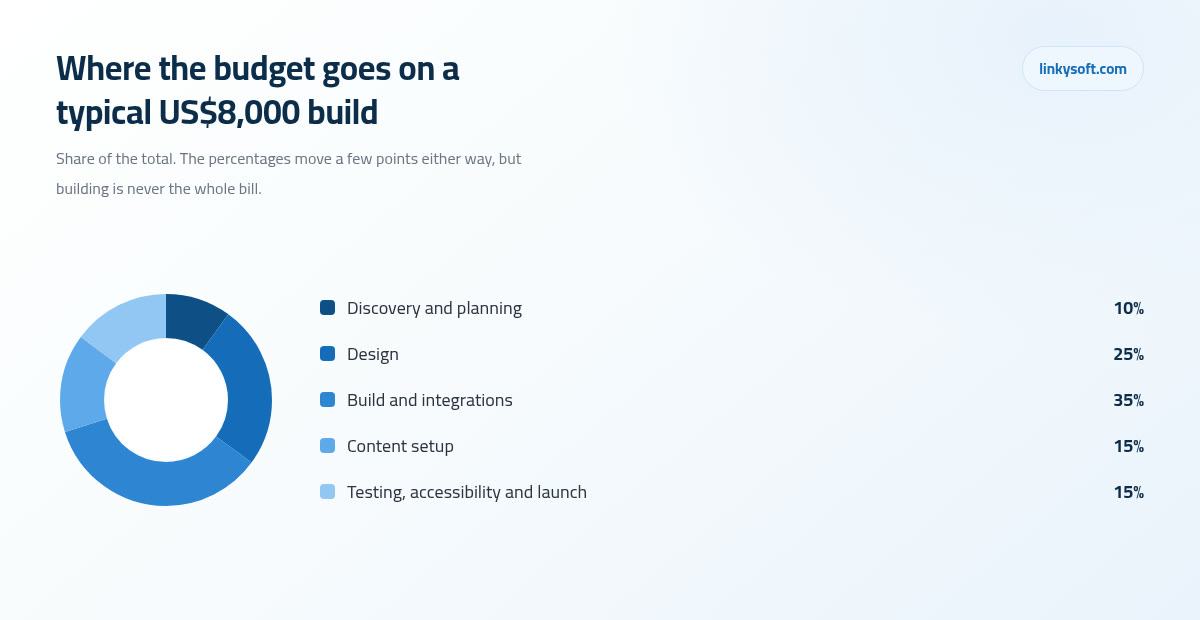
Those two lines are worth defending. Discovery is where somebody writes down what the site has to do, which pages exist and what happens when a form is submitted, so skipping it does not remove the decisions, it just moves them later and hands them to whoever happens to be at the keyboard that afternoon. Testing is where the site meets real phones, real browsers, a slow connection, and a screen reader, which is the software that reads a page aloud to a blind visitor. Delete both and you save around US$2,000 on the day, then pay for the same work again when the checkout fails on an iPhone in week three and everything stops.
The red flags in a quote, in roughly the order they should worry you: no page list, no named integrations, "SEO included", meaning search engine optimisation, the work of getting your pages to turn up in Google results, with nothing defined underneath it, no list of the browsers and devices covered, hosting not mentioned anywhere, and no support window after launch. Each one is a place where the price can quietly grow later, which is exactly the moment when you are in the weakest position to argue about it.
For the sake of being concrete about it, a Linkysoft quote names the pages, names the integrations, fixes the scope and states a price per extra layout up front, so that adding a page in week five is a number you already agreed to rather than an argument neither side enjoys having.
The Bill That Arrives Every Year After Launch
A website is less a purchase than a small ongoing commitment, and the annual numbers are modest as long as nobody is surprised by them. Hosting, which is the rented computer your site lives on, runs US$5 to US$50 a month for a small site and US$40 to US$200 for a busy store, while the domain name adds another US$10 to US$40 a year on top of that. The SSL certificate, meaning the padlock in the address bar that encrypts whatever a visitor types into your forms, is free and included in almost every case these days, so nobody should be billing you separately for it.
Maintenance is the line that gets forgotten. Budget US$50 to US$300 a month, or use the rule of thumb of 15 to 20 percent of the build cost per year, which puts an US$8,000 site at roughly US$1,200 to US$1,600 a year to keep safe and current.
What that money buys is unglamorous and genuinely necessary: software updates, backups that somebody has tested by restoring them, uptime checks so that you hear about an outage before a customer does, small content edits, and the security patches that stop a site being defaced or quietly turned into a machine for sending spam. If you are weighing up where to host and how much upkeep to buy, there is plenty in our writing on hosting that will save you a phone call.
The honest point to finish on is this. A site nobody maintains is cheaper in year one and dearer in year three, because neglected sites do not fail gracefully, they fail suddenly and at the worst moment, and a rebuild always costs more than the upkeep would have.
Fixed Price, Day Rate, or Monthly Retainer: Which One Protects You
Fixed price is the safest arrangement for a buyer, because the risk of the work running long sits with the supplier rather than with you. That protection is not free, since any sensible fixed price carries a built in risk margin of roughly 10 to 20 percent, and it only works when the scope has been written down properly. A fixed price on a vague scope is a fight waiting to happen.
A day rate, sometimes called time and materials, runs US$300 to US$900 a day depending on the market and the seniority of the people doing the work. It is genuinely cheaper when nobody yet knows what is being built, since you are no longer paying for the supplier's uncertainty, and it needs one protection in writing: a weekly spending cap, so that the meter cannot run while you are away.
A retainer after launch runs US$500 to US$3,000 a month and buys continuous improvement rather than a finished object. It suits a site that earns money and ought to keep getting better, and it makes very little sense for a brochure site that nobody intends to change.
A few payment norms worth knowing before you sign anything. A deposit of 30 to 50 percent is normal, schedules are usually 40/30/30 or 50/50 against agreed stages, and changes made mid build typically add 10 to 30 percent to the final invoice unless the page list was agreed first. That last figure is the strongest argument there is for spending an afternoon on scope before anybody opens a design tool.
When the Cheap Option Is Genuinely the Right One
Not every business should spend more, and pretending otherwise is how agencies lose clients they could have kept for a decade. The cheap route is the correct route when you are testing a new idea and do not yet know whether anybody wants it, when you are a single service business living on word of mouth, when your customers all buy by phone or across a counter anyway, and above all when your real bottleneck is being found rather than being built.
In numbers, that route is a fitted template across three pages plus hosting, live for US$1,500 to US$1,800 all in and then US$15 to US$30 a month to keep running. A three page site done well beats a twenty page site done badly every single time, because a visitor arrives wanting to know what you do, whether you are near them and how to reach you, and those three answers sit comfortably on three pages.
We tell clients to spend less whenever the money would do more elsewhere, and the alternatives are usually obvious once somebody says them out loud: proper photography of the real premises, a modest advertising test to find out what a customer actually costs to win, or simply answering enquiries within the hour instead of the following day. Any one of those can beat a bigger website bought on the same budget.
The line where cheap stops being thrift is clear enough, though. If you take payments, store customer records, work in anything regulated such as health or finance, or if the site is the main way the business sells, then the cheap route becomes exposure rather than economy and you should budget properly.
Three Real Budgets and What We Would Do With Each
US$2,500. A fitted template across six pages, your own photographs rather than stock images, an enquiry form that lands in your inbox and in a list you can sort, and basic analytics so you can see what people actually look at. Live in about four weeks, with US$300 held back for the first year of hosting and the domain. Whatever you do, do not spend that last US$300 on a seventh page.
US$9,000. Custom design across six layouts, a booking or quote flow, two languages if you genuinely serve two language groups, and a link to your CRM so that enquiries stop being retyped by hand. Eight to ten weeks, with US$1,200 kept back for year one maintenance and a first advertising test, because a site nobody visits is a very expensive brochure.
US$30,000. A store or a customer portal with logins, payments and a connection to your accounting software. Four to six months, and we would deliberately split it into two releases so that the first one is live and earning while the second is still being built, since anything shipped in one go is everything waiting on the slowest piece.
One short note for readers who are really asking about an app rather than a site, meaning something people install on a phone: the shape of the budget changes, and mobile app development is the better place to start reading. Comparable work at all three of these sizes sits in our case studies, which is a faster way to calibrate expectations than any price list.
Whichever band you are in, ask for the estimate to be built up line by line rather than pulled out of the air, because a number with no page list underneath it is a guess wearing a suit. Linkysoft will put that breakdown together with you, including the parts we think you should not buy, so talk it through with us before anybody designs anything.