What a missed appointment really costs your clinic
Take a clinic with five clinicians, each with twenty four slots a day, open twenty two days a month. That is 2,640 booked appointments a month, and it is a number you can check against your own diary in about a minute. Now apply a miss rate of 18 percent, which is roughly where a busy general clinic with no reminder system tends to sit, and you are looking at about 475 empty slots every month. If an average visit is worth 40 US dollars to you, those slots represent roughly 19,000 dollars a month, or around 228,000 a year, of capacity you have already paid for and never sold. Every amount in this article is written in US dollars, and if you work in another currency you can drop your own average visit price into the same sum, because the arithmetic behaves exactly the same way.
That figure lands hard because almost none of the cost went away when the patient stayed at home. The clinician was still there, the room was still lit and staffed, reception was still open and the salaries were still paid. A missed appointment is not a lost sale in the ordinary sense, because in an ordinary business the unsold item can be sold tomorrow, whereas a Tuesday at ten past three cannot be sold to anybody, ever.
Then there are the costs that never appear on an invoice. Your receptionist spends real minutes chasing and rebooking, and those minutes come out of the queue standing in front of her. Somebody else waited three weeks for that exact slot and would have taken it gladly. And the day bunches up in an ugly way, because gaps in the morning push the afternoon into a rush, which is how clinicians end up finishing late on the days that looked quietest on paper.
One thing needs saying plainly before we go further, because it frames everything that follows: the target is not zero. Across the clinics we work with, a general outpatient practice typically runs between 10 and 20 percent, a specialist clinic with a long waiting list can run 25 to 40 percent, and dental and aesthetic clinics that take a deposit sit at 3 to 8 percent. A healthy clinic lands somewhere around 5 to 8 percent, and squeezing out the last few points after that almost always costs more than the slots are worth. So the job is not perfection. The job is getting from wherever you are down into that band without spending the savings twice over.
Why patients actually miss appointments
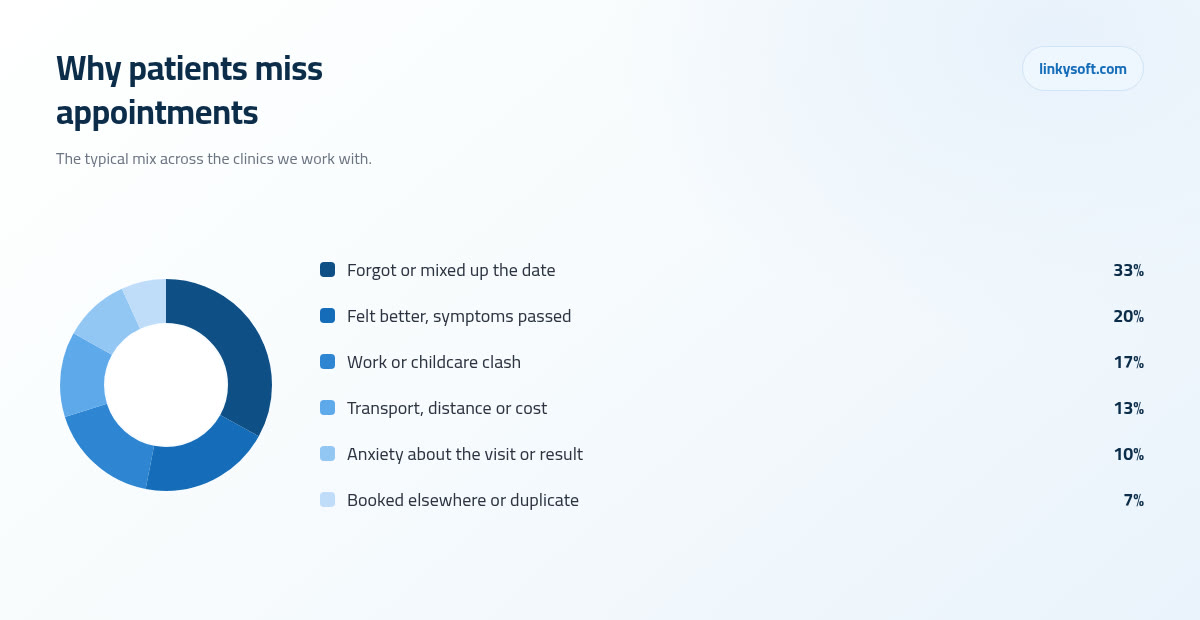
When clinics ask patients why they did not come, and they should ask, the answers cluster in a way that is remarkably consistent. Roughly a third simply forgot, or had the date muddled in their head and were certain it was next Thursday. About a fifth felt better, because the symptom that frightened them into booking three weeks ago has quietly settled and the visit no longer feels urgent. After that come work and childcare clashes, then transport, distance and cost, then anxiety about the visit itself or about what a result might say, and finally a smaller group who booked somewhere else in the meantime and never thought to tell you.
That mix matters because it splits neatly into two halves, and the split decides where your money should go. Roughly half of all misses are a memory or logistics problem, which is exactly the sort of thing software fixes cheaply and reliably, since a message at the right moment genuinely does solve forgetting. The other half are a scheduling problem, a money problem or a fear problem, and there software only assists. No reminder ever persuaded a patient who cannot get away from work at eleven on a Tuesday, although a system that lets them move the visit to Saturday morning in two taps might.
One more pattern is worth knowing before you plan anything, which is that first-time patients miss at roughly twice the rate of returning patients. They have no habit with you yet, no memory of the building, no relationship with the clinician and nothing invested beyond a phone call they made once. That is why first visits deserve different handling from the rest of your diary, and we come back to it later on.
The strongest predictor is how long the patient waits
If you take only one thing from this article, take this one. Lead time, meaning the gap between the day an appointment is booked and the day it happens, predicts misses better than almost anything else you could measure. Booked one to three days ahead we typically see 5 to 10 percent missed. Stretch that to two weeks and it climbs to 15 to 20 percent. Between fifteen and thirty days it runs 20 to 30 percent, and beyond a month it is commonly 30 percent or higher, which means a clinic with a six week waiting list is quietly losing close to a third of its diary no matter how good everything else is.
The reason is human rather than clinical. A great deal happens in six weeks, because shift patterns change, children get ill, holidays appear and cars break down. Symptoms resolve on their own, so the worry that drove the booking fades away. And the appointment slowly loses its place in the patient's memory, since it was made in a completely different week from the one it lands in and nothing in between has reminded them that it exists.
The fix costs nothing, and most clinics resist it at first: hold back 20 to 30 percent of next week's slots for short-notice booking instead of letting the diary fill out to the horizon. Leaving gaps in a diary people are queuing for feels wasteful, but the arithmetic is not close. A slot given to somebody who needs care in three days is kept nine times out of ten, while the same slot handed out for a date five weeks away is kept perhaps seven times out of ten, so you are releasing capacity that gets used rather than capacity that gets wasted.
This also changes how you should read your own reports, and there is a trap here worth naming. Do not judge any clinician's no-show rate until you have looked at their waiting time first, because the doctor with the worst miss rate in your clinic is very often simply the most in demand, and their patients are the ones waiting three weeks. That is a capacity problem wearing a discipline problem's clothes, and no reminder in the world will rescue it.
Reminders that work, and the ones patients ignore
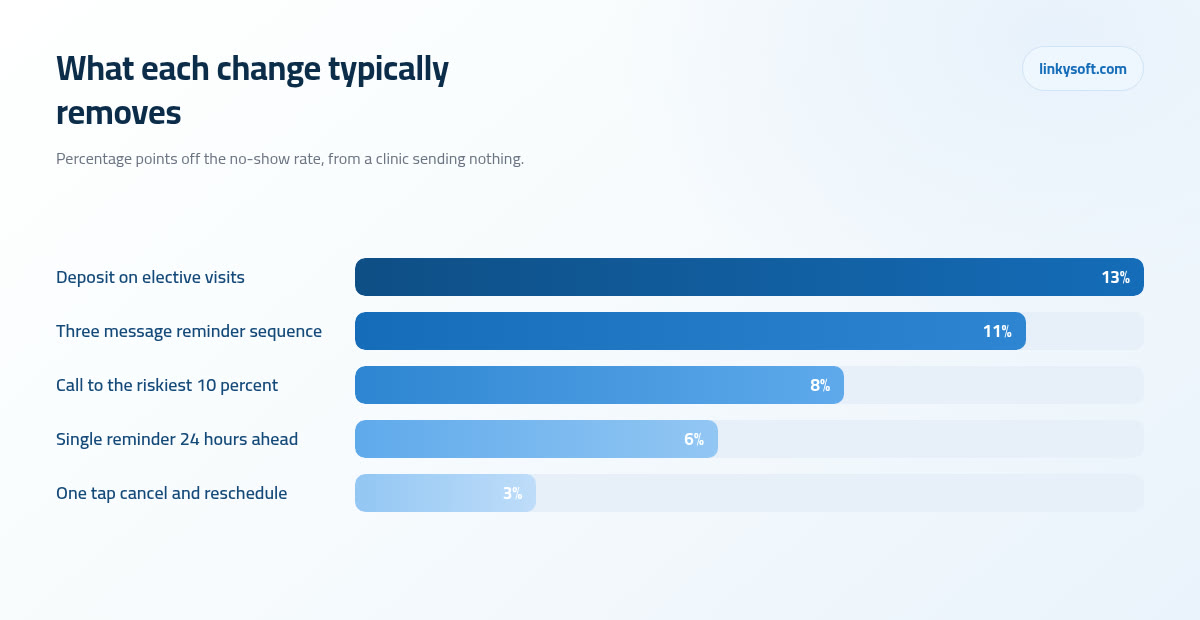
Reminders are the cheapest item on this list and the one most clinics get slightly wrong, usually by sending a single message the day before and then concluding that reminders do not work. The sequence that does work has three parts. First a confirmation the moment the booking is made, while the patient is still paying attention, which also puts the date in front of them in writing. Second a reminder 48 to 72 hours ahead, and that timing is deliberate, because a patient who tells you on Monday that Thursday is impossible has given you two working days to sell the slot to somebody else. Third a short nudge two to four hours before the visit, which catches the person who fully intended to come and lost the morning.
The difference between the two approaches is measurable. A single reminder 24 hours ahead typically takes 5 to 8 percentage points off a clinic's miss rate, which is real money and worth having on its own. The full three message sequence typically takes 8 to 14 points off, because each message catches a different kind of forgetting. On the 2,640 appointment example, three messages each works out at roughly 80 to 400 dollars a month, since a single message costs somewhere between one and five cents, and that sits against 19,000 dollars a month of exposure, so this is not a decision that needs a business case behind it.
Channel matters more than people expect, and the rule is simply to match the channel to the patient rather than picking whichever one suits the clinic. SMS or WhatsApp works for most people. Email suits corporate and insured patients, who read it at a desk and often need to forward it to somebody in an office. An automated voice call is the right answer for older patients who do not read messages at all, and clinics that skip that one usually have their worst numbers hiding in precisely that group.
Then the content rules, which are short. Name the clinician, give the exact address, say what to bring, say how long the visit will take, and ask for one single action. Nothing else belongs in there, and in particular no marketing, because the moment your messages start carrying offers people stop opening them and you will have spent your most valuable channel on a whitening promotion. The test for good appointment reminders is whether a patient could read the message and act on it in five seconds without scrolling.
Make cancelling one tap, because a cancellation is good news
Most clinics have this backwards. A cancellation feels like a loss and a no-show feels like bad luck, when in truth a cancellation two days ahead is a slot you can sell again and a no-show is a slot that is simply dead. So your whole job is to make cancelling easier than staying silent, and if the easiest thing an uncomfortable patient can do is nothing at all, nothing is what you will get.
In practice that means a link inside every reminder offering three options and no more: confirm, cancel or reschedule, each of them a single tap. Clinics that add this typically convert 10 to 20 percent of would-be no-shows into cancellations they can still fill, and that conversion is where the money sits, because 60 to 80 percent of cancellations made more than 24 hours ahead can be refilled from a waiting list.
The replies also hand you something you never had before. Between 40 and 70 percent of patients respond to a confirm or cancel link, and the silent group misses at two to three times the rate of those who reply. That makes non-response the cheapest risk flag a clinic will ever get, because your receptionist no longer has to guess who is worth phoning. She phones the people who did not answer.
One warning, because it costs clinics most of the benefit when they get it wrong. Never ask a patient to log in, install an app or type a reference number in order to cancel. Every extra step pushes a real share of people back to the default, which is saying nothing and not turning up, so the link has to work on a five year old phone, straight from a message, with no password anywhere near it.
The waiting list is where the money comes back
A cancellation only turns into money if you can refill it, so the second half of the machine is a standing list of patients who have already said yes to an earlier slot. That last part is the important bit, because a waiting list is not everybody booked in the future, it is the smaller group who told you explicitly that they would take a nearer date if one appeared. Ask that question at the moment of booking and the list builds itself.
Automation makes a bigger difference here than anywhere else in this article. An automated offer to that list refills a freed slot in roughly 20 to 90 minutes, because it goes out within seconds of the cancellation and lands with people who were already waiting for it. A receptionist working down a paper list refills about one in three the same day, not because she is slow but because she is ringing people who are at work, one at a time, in between everything else she is doing.
How you offer matters too. Send to small batches of five to ten matching patients at a time with a claim window of about 15 minutes, so that you neither double-book the slot nor train your list to ignore you by offering appointments that are always gone by the time anyone replies. Matching means the right clinician, the right visit type and, where it applies, the right room or machine.
Here is the arithmetic that usually settles the argument. If your clinic produces 200 cancellations a month and you refill 60 percent of them at 40 dollars a visit, that is about 4,800 dollars a month recovered, which on its own covers the cost of most reminder and scheduling systems several times over, and it is entirely separate from the misses your reminders prevented in the first place. This is also the piece that most often justifies building something properly, and it is where we spend most of our time when we build a booking and waiting list engine for a clinic, because the rules about who gets offered what are always specific to the practice.
Deposits, fees and overbooking, the honest version
Deposits work, and it would be dishonest to pretend otherwise. A refundable deposit of 5 to 15 percent of the visit price, taken at booking and either returned or credited against the bill, reliably holds no-shows under 5 percent, which is exactly why dental and aesthetic clinics report the lowest numbers in the whole sector. For elective, cosmetic and high value appointments it is the single most effective lever you have.
Now the cost, stated honestly, because this is where most articles go quiet. Expect 5 to 12 percent of would-be bookings simply never to be made, since some patients will not or cannot put money down in advance and others read the request as a sign that you do not trust them. For a private aesthetic clinic that trade is usually excellent, because the bookings it deters were the least committed ones anyway. For a public-facing clinic, a lower income catchment, or any practice where the visit is medically necessary rather than chosen, it is usually the wrong trade, and we would tell you not to do it.
The same honesty applies to no-show fees. A fee you never actually collect is worse than having no policy at all, because it sits in your terms, patients notice within a month that nothing happens, and it quietly teaches everybody that your rules are decorative while returning nothing to the bank. Either collect it consistently, with a clear and human process for exceptions, or take it out of your terms altogether.
Overbooking is the last lever and easily the most dangerous. Only overbook slot types that genuinely miss above 25 percent, never add more than one extra appointment per session, and never overbook anything that needs a room, a chair or a machine, because two patients cannot share a scanner. Get this wrong and you punish precisely the people who did turn up on time, which costs you the loyalty of the patients you most want to keep.
Know your number before you spend anything
You cannot manage a number you have not defined, and clinics define this one inconsistently more often than not. The no-show rate is missed appointments divided by booked appointments, with cancellations counted separately on their own line. Folding the two together hides the problem entirely, because a clinic that counts them as one thing can be improving and getting worse at the same time and never notice either.
A single overall number is not much use on its own, so slice it four ways: by clinician, by day of the week and time of day, by lead time, and by booking channel, meaning phone, walk-in, website or referral. The fix nearly always lives inside one slice rather than spread across the clinic, and when a practice finally looks properly it usually turns out to be something specific, such as new patients on Monday mornings, or everything booked more than three weeks out through the website.
Look at it weekly rather than yearly. A clinic that checks once a year can never tell whether a change worked or the season simply shifted, since school holidays, Ramadan, summer and flu season each move the number by several points all by themselves. Weekly figures are noisier, but they let you see a step change on the week you make one, and whatever reports your system produces are only worth having if somebody actually opens them on a fixed day.
Finally, the discipline most clinics skip: measure a clean two week baseline before you change anything at all. Without it, every improvement you claim afterwards is a story rather than a result, and you will never know which of the four things you switched on in the same fortnight was the one that did the work.
Give the high risk appointments the human treatment
Not every appointment deserves the same effort, and treating them all identically is how clinics end up spending receptionist hours on patients who were always going to arrive anyway. Score the risk instead, using things you already know at the moment of booking: is this a first visit, is the lead time more than three weeks, has this patient missed before, do they live a long way from the clinic, and is the slot early in the morning. Five plain flags, one point each, no cleverness required.
The reason this pays is that the riskiest 10 to 15 percent of bookings produce a large share of all your misses. A ninety second call from a real person to that small group is money well spent, whereas the same call made to everybody becomes a full-time job that returns very little, so you are concentrating the human effort exactly where the automated messages are weakest.
Of those flags, a previous no-show is by far the strongest. A patient who has missed once is two to three times more likely to miss again, which means that single field, recorded properly and visible to whoever is doing the booking, is worth more than any other piece of data in your system.
How the call is made decides whether it works at all. Keep it helpful rather than accusing, so the question is simply whether that time still suits and whether they would like to move it. That tone recovers the slot, because a patient offered a graceful way out will take it, and it keeps the patient, because nobody enjoys being told off by their clinic. It is also worth saying that none of this requires artificial intelligence, since five flags and a sort order will do the job in any decent system. Predictive risk scoring, meaning software that studies your booking history and learns for itself which appointments tend to fail, only starts to earn its price in a group running several sites with years of records behind it, which is a long way above the five clinician practice we have been costing here.
What to look for in a clinic management system
When you go shopping, the list of features that actually moves this number is short, and everything else is decoration until these five are in place.
- Automated multi-step reminders that can send on more than one channel.
- A one tap confirm, cancel and reschedule link that needs no login.
- Waiting list auto-fill that offers a freed slot without anyone pressing a button.
- Patient self-rescheduling, so moving an appointment does not need a phone call.
- A no-show report you can slice by clinician and by lead time.
It is just as useful to know what to ignore, at least at the start. Patient apps that nobody installs, website chatbots and loyalty modules all demonstrate beautifully in a sales meeting, and none of them touch this number. Buy them later if you want them for other reasons, but do not let them decide the purchase.
On money, be concrete. Off-the-shelf clinic systems with reminders and a waiting list typically run 15 to 60 dollars per user per month, so a five clinician practice with three reception logins might pay somewhere between 120 and 480 dollars a month all in. A custom build tied to your own rules, your own message sequence and your own way of matching patients to freed slots is typically 8,000 to 35,000 dollars once. Judge that against what the plan actually recovers rather than against the whole 19,000 a month of exposure, because no clinic recovers all of it: moving from 18 percent to 10 percent across 2,640 appointments puts about 211 visits a month back in the diary, which at 40 dollars each is roughly 8,400 dollars. On that basis a build at the bottom of the price range has paid for itself in about a month and one at the top in a little over four, which is still unusually quick for anything a clinic buys.
And here is where the cheaper answer is genuinely the right one. A single-clinician practice with 30 appointments a week does not need a platform, because at that volume the whole problem is one person's routine. A shared calendar, a fixed messaging habit and a two minute call to anybody booked more than three weeks out will capture most of the benefit for the price of nothing. We are Linkysoft and we build exactly this kind of thing for clinics, whether that is a scheduling web application your staff live in all day or a patient facing mobile app where one is truly warranted, so we say that from experience rather than modesty: below a certain size, buying software is the expensive way to fix a habit.
A realistic plan for your next 90 days
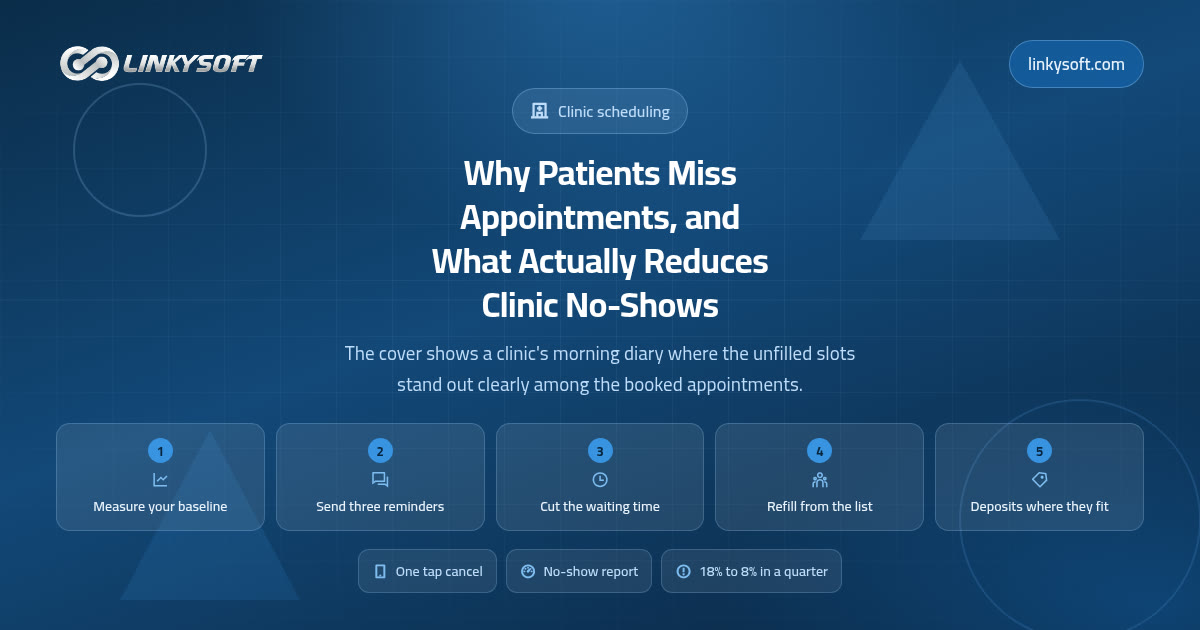
Weeks one and two are for measuring, and for changing absolutely nothing. Record the baseline, slice it the four ways described above, and resist every urge to fix something, because this fortnight is the only chance you get to know where you started from.
Weeks three and four are for the reminder sequence, with the one tap cancel link inside it. This is the cheapest change with the largest single effect, which is why it goes first. Write the messages properly, send them to your own phone before anyone else sees them, and check that the cancel link really does work without a login.
Weeks five to eight are for the waiting list and its automatic offer. Start asking the yes or no question at every booking so the list grows on its own, and begin phoning the riskiest 10 percent of bookings by hand. This is the stretch where the recovered money starts showing up in the diary instead of in a spreadsheet.
Weeks nine to twelve are the only sensible moment to consider deposits, overbooking or replacing your system altogether, and each one should be judged against the baseline you measured in week one rather than against how it feels in the corridor. Most clinics find they need one of the three, not all of them.
Set your expectations honestly while you are at it. A clinic starting around 18 percent should expect to be at 8 to 10 percent within a quarter, and that is a good result rather than a disappointing one. Anything dramatically faster is usually a change in how somebody counted rather than a real improvement, and chasing zero will cost you more in deterred bookings and staff hours than the last few slots were ever worth.
You can do every part of this without us, and plenty of clinics have, which is why the arithmetic here is deliberately the kind you can check on paper with a pen. If you would rather have the whole thing built around your own rules than bend your clinic to fit somebody's product, that is the work Linkysoft does, and our case studies show what those systems look like once they are running. Send us your current numbers through our contact page and we will tell you plainly whether a build is worth it for you, or whether a cheaper routine would get you most of the way there.