What you are actually buying when you buy a clinic system
The word "system" hides a great deal, so it is worth opening it up before anybody talks about price. What a clinic actually buys is a set of connected parts, and every one of those parts replaces something that already exists in the building, usually on paper. Seen that way the price stops being mysterious, because you can point at each part in turn and ask whether you genuinely need it this year.
- The patient file is the digital version of the folder in the cabinet behind reception: history, allergies, visit notes, prescriptions and scans, all findable by name or phone number in a second or two.
- The appointment book replaces the paper diary, with the useful difference that it can send the reminder by itself and can show you tomorrow across three doctors on one screen.
- Invoices and receipts handle the money at the desk: what was charged, what was paid, what the insurer still owes you, and what has been sitting unpaid for more than thirty days.
- Pharmacy stock knows how many boxes are on the shelf, what expires next month, and what has to be reordered before Thursday.
- Lab and radiology orders send the request to the technician and bring the result back into the right patient file instead of into a pile on somebody's desk.
- Owner reports are the screens that tell you what the month earned, which doctor and which service earned it, and where the money is quietly leaking out.
Now for the single biggest fork in the road, because it moves the price by a factor of five or more. A clinic system assumes that patients arrive, are seen and go home the same day, so it needs one or two sites, a queue, a consultation note and a till. A hospital system has to run beds, and that is not a small addition to the same idea, it is a different animal: admissions and discharges, a medication round that happens four times a day whether anyone is watching or not, a handover at every shift change so the night nurse knows exactly what the day nurse did, theatre lists, and a budget per department that the finance office has to close at the end of each month. Everything in a hospital costs more because everything in a hospital has to work at three in the morning.
The second thing worth understanding early is what the bill actually follows, because clinics usually guess wrong here. The price is driven by how many modules you switch on and how many people log in, and only very rarely by how many patients you see. That produces results which feel unfair at first sight, since one very busy doctor with a single receptionist can easily pay less than a quiet clinic with nine staff accounts, simply because the busy practice is buying two logins and the quiet one is buying nine.
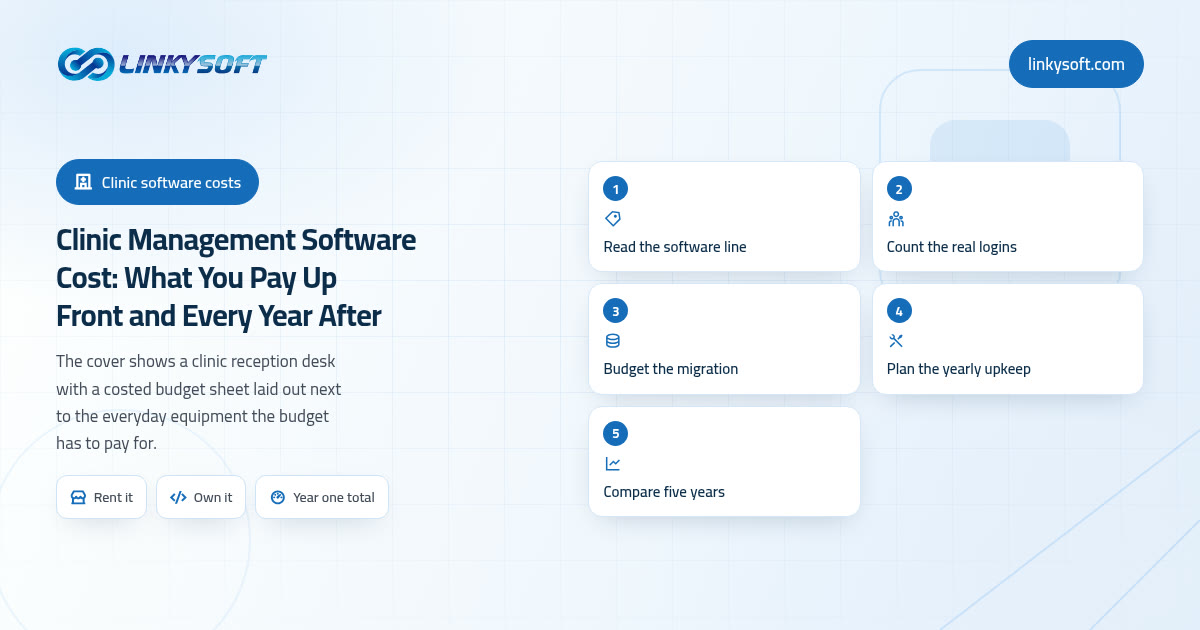
The last point before the numbers start is the one this whole article is built on. The quote in front of you is one line of a bill that has roughly five lines in it, and the other four are data migration, training, hardware at the desks, and the connections to outside systems. What follows fills in those four, with the arithmetic written out so you can drop your own figures into it as you read.
The three ways clinic software is priced, in plain words
Monthly subscription per user, which means you are renting
You pay a fee for every login every month, usually 25 to 80 USD per user, and in exchange there is nothing to pay up front, the hosting and the updates are included in the price, and somebody else is responsible for keeping the thing alive. The catch is written into the model rather than hidden in the contract, because the payment never stops, it tends to creep upward at each renewal, and after eight years of paying you own nothing at all apart from your own records, assuming the agreement lets you take them.
A one time licence plus yearly maintenance, which means you are buying a copy
Here you buy the right to install and run the software, commonly 3,000 to 15,000 USD for a small site, and then you pay 15% to 22% of that licence value every year to stay supported and to keep receiving updates. A 10,000 USD licence therefore carries 1,500 to 2,200 a year behind it for as long as you use it, and if you decide to stop paying that, the software usually keeps running while quietly going out of date, which is close to the worst possible outcome for a business holding medical records.
A custom system built for you and owned by you
You pay once for the build and then a smaller amount each year to keep it hosted, patched and gradually improved. A focused build covering patient files, appointments, invoicing and owner reports typically lands between 18,000 and 60,000 USD across 10 to 16 weeks, while a full hospital build with inpatient care, pharmacy, lab and insurance claims sits closer to 70,000 to 250,000 USD across 6 to 12 months. What you hold at the end is an asset rather than a receipt, which matters more to some owners than to others.
The right way to compare these three is on cash flow rather than on the headline number, because the headline flatters renting and punishes building even in the cases where building is correct. Renting is small and permanent, buying a licence is medium then small and permanent, and a custom build is large once then modest afterwards. A clinic with money in the bank and a stable team is in a different position from one that is still finding its feet and needs every spare pound for a second treatment room.
There is one more comparison that almost nobody makes at signing time and everybody makes eventually, which is what each option means on the day you decide to leave. Ask, in writing, how your data comes out, in what format it arrives, how long a full export takes, and whose signature is needed to release it. A rented system that exports every patient file, every visit note and every invoice as ordinary spreadsheet files within five working days is a very different proposition from one that offers you a screen by screen printout, and that single difference can be worth more than the whole first year of savings.
What a small clinic pays in the first year
Take a real shape rather than an abstract one: one doctor, a receptionist, a nurse, and an accountant who comes in two days a week. That is four people who need their own login, so the software line on its own is four logins at 25 to 80 USD each per month, which is 100 to 320 a month and roughly 1,200 to 3,800 USD across the year. That is the number the vendor quotes, and it is genuinely the biggest single line, but it is not the year.
Here is the rest of year one for that same clinic, with the ranges we see in practice:
- Light data migration, meaning a few thousand patient records typed or imported from a spreadsheet and checked: 400 to 1,200 USD.
- Training, six to twelve hours spread across the four people, including a session after the first fortnight when the real questions finally arrive: 300 to 900 USD.
- A reception PC that will not make the queue wait: 400 to 700 USD.
- A thermal label printer for sample and file labels: 150 to 400 USD.
- A barcode scanner so the receptionist stops typing file numbers: 30 to 80 USD.
- A small UPS so a power cut does not lose the morning's work: 80 to 200 USD.
Add those to the software line and the honest first year lands somewhere near 3,000 USD at the careful end and 7,000 at the comfortable end, which is why we tell clinics of this size to plan for about twice the quoted subscription rather than for the subscription alone. Nothing in that list is optional in the way a spare monitor is optional, because every item on it is what turns a licence into a working reception desk.
Then the part that costs a clinic this size real money if it gets it wrong: a four person practice should subscribe to something ready made and should not commission a custom build. The reason is simple arithmetic rather than modesty about what we do, because a clinic of this shape needs a patient file, a calendar, an invoice and a monthly report, and every decent product on the market already does all four. Paying 25,000 USD to have them built again buys you a slightly better fit and a great deal of waiting, and the waiting is the expensive part. If you want to read further about the one area where small clinics genuinely differ from each other, it is worth reading about appointment scheduling on its own, since that is where the practical differences between products actually show up.
What a group practice or polyclinic pays
The next band up is 5 to 20 users across two or three branches, usually with several specialities under one roof, and this is where the first real complication appears. That complication is almost never the extra doctors, because a doctor is just another login. It is insurance claims, and everything that travels with them: the approval before treatment, the coding of what was done, the submission file the insurer expects, the rejections that come back, and the resubmission that somebody has to chase.
So the jump between a small clinic and a group is driven by three things rather than by headcount. The claims module is the first and the largest. The second is the per branch fee that most vendors charge, because a second site is a second set of stock, a second till and a second appointment calendar. The third is consolidated reporting, meaning the owner wants one screen showing all three branches together as well as each one separately, which sounds trivial and is a genuine piece of engineering.
In practice a group of this size lands on a first year total of 6,000 to 25,000 USD, with the software line itself somewhere between 3,000 and 14,000 depending almost entirely on how many people genuinely need their own login. At 5 users on a mid range plan you are near the bottom of that band, and at 20 users with claims and two branch fees you are near the top of it.
Which brings up the shortcut that clinics of this size reach for, and the reason it is a bad trade. When the price is per user, the obvious way to reduce it is to have three receptionists share one account, and it works exactly as intended: the bill goes down. What goes down with it is the audit trail, because the system can no longer tell you who opened a patient file, who changed a dosage, or who cancelled an invoice at nine in the evening. That record is the one thing you cannot buy back later, and it is the thing you will want on the day a patient disputes what was written or a stock count comes up short. Saving 55 USD a month is not worth it, and every clinic that has ever needed the log has said so afterwards.
What a hospital pays, and why the number jumps
A hospital is not a large clinic, and the price reflects that in a way that surprises people who expected a linear increase. What changes is the list of things that simply do not exist in outpatient work:
- Beds and admissions, which means knowing who is in which bed, since when, under whose care, and what happens when the ward is full.
- Inpatient medication rounds, where a nurse records what was given and when, four or more times a day, and a missed entry is a clinical problem rather than a paperwork problem.
- Pharmacy stock valued in the hundreds of thousands, with expiry dates, controlled substances and a stock count that has to reconcile.
- Lab and radiology machines that must talk to the system directly, so a result arrives electronically rather than being retyped by a tired technician.
- Insurance portals, often several of them, each with its own file format and its own rules.
- Support that answers at three in the morning, which is a contract line with a real price attached, not a promise.
Put those together and a hospital's first year runs from about 40,000 USD to 250,000 USD or more, with 6 to 12 months before the whole building is genuinely live rather than partly live. Those two words matter, because a hospital that has registration and billing running while the wards are still on paper is not finished, and calling it finished is how projects quietly fail.
The way to control that cost is a phased rollout, and it deserves to be understood as a cost control rather than as a delay. Registration and billing go first, because they touch every patient and pay for themselves immediately. Pharmacy and lab follow, because they carry the stock value and the biggest sources of leakage. Inpatient care goes last, because it is the hardest and it benefits most from a staff that already trusts the system. The hospital pays in stages, learns between the stages, and arrives at the difficult part with people who already know how to use the software.
One line that hospitals routinely forget to budget: training 60 or more staff across three shifts is its own project. You cannot train a night shift during the day, you cannot take a ward off the floor for four hours, and you will be running the same session five or six times. Put a real figure against it in the budget rather than assuming it is folded into the software price, because it very rarely is.
The costs that never appear on the quote
This is the section that turns a 6,000 USD quote into a 10,000 USD year, and none of it is anybody being dishonest. It is simply that a software quote prices software, while a clinic is buying a working reception desk.
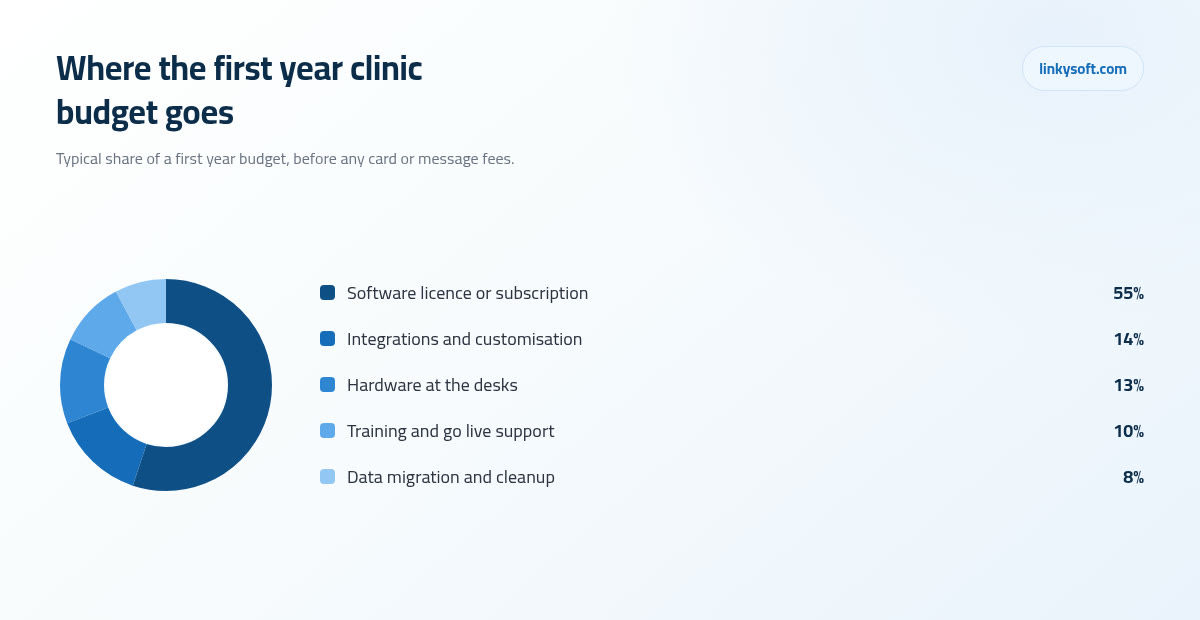
Moving the old records across
Migration usually takes 5% to 12% of the first year budget, and the work is mostly cleaning rather than importing. A clinic holding around 20,000 patient files should expect 2 to 5 working days of cleaning plus one rehearsal import before the real one, and the rehearsal is not optional caution, it is the step that finds the problems. It always finds the same problems too: the same patient entered three times with slightly different spellings, phone numbers missing or belonging to a relative, dates of birth that were guessed, and a column of notes that somebody used for six different purposes over nine years.
Training, and the part nobody quotes
Formal training runs 2 to 6 hours per role, which is easy to price. The honest part is what happens afterwards, because output drops 20% to 30% for the first two to four weeks while people learn where things are. Follow the arithmetic on a five person team over three weeks: each person works about fifteen days in that stretch and gives up roughly a quarter of the pace, so each one loses close to four full working days, and across the five of them that is somewhere near nineteen working days of capacity. Nobody invoices you for it, but you pay it, and clinics that plan a slightly lighter appointment book for the first fortnight pay noticeably less of it.
Hardware at the desks
Real prices for the things the software runs on: a reception PC at 400 to 700 USD, a thermal label printer at 150 to 400, a barcode scanner at 30 to 80, a tablet for each consultation room at 200 to 400, a small UPS at 80 to 200, and a backup internet line at 20 to 60 USD a month. That last one looks like an indulgence until the day the main line goes down and a cloud based system takes the whole clinic with it.
Every outside connection is priced separately
A lab machine, an insurance portal, a payment gateway or a national patient ID each typically adds 1,500 to 6,000 USD and one to three weeks, and they add it one at a time rather than all together. Two integrations is therefore not a rounding error on a 6,000 USD quote, it is potentially another 6,000 and another month, so the time to list them is before you sign rather than in week seven.
Put all of it together and the pattern is consistent enough to plan around: year one costs 1.5 to 1.9 times the software line on the quote. A 6,000 USD quote is realistically a 9,000 to 11,400 USD year, and a clinic that budgets for the quote alone will be asking for more money in month three.
The bill that arrives every year after go live
Year one gets all the attention because it comes with a signature attached, but the year after go live is the number you will live with for a decade, so it deserves the same arithmetic. It has four parts, and only the first one usually appears in the sales conversation.
Keeping the system alive. Hosting runs from 40 USD a month for a small single site to 400 a month for something substantial, and backups belong in this line rather than as an afterthought, with the important condition that a backup counts only if somebody has actually restored it as a test. On a system you own, the support and update contract runs 15% to 20% of build value, so a 40,000 USD system carries roughly 6,000 to 8,000 USD a year to stay patched, supported and slowly improved.
Messages, which scale with how busy you are. Appointment reminders cost about 0.01 to 0.05 USD each, so a clinic sending 60 a day sends 21,900 in a year and pays somewhere between 220 and 1,100 USD for them. That is one of the few lines that pays for itself in plain sight, because no show rates typically fall from around 20% to between 8% and 12% once reminders go out reliably, and for a clinic seeing 40 patients a day at an average ticket of 35 USD, recovering even eight appointments a week is worth far more than the messages cost.
Card and online payment fees. These run 1.5% to 3% plus a small fixed amount per transaction, and they never appear anywhere near a software quote because they belong to the payment provider. A clinic taking 30,000 USD a month by card pays roughly 450 to 900 USD a month in fees, which is 5,400 to 10,800 a year of real money leaving the business through a door most owners have never looked at.
Growth, which costs money on a rented system. Every new receptionist is another monthly line, every new branch is another branch fee, and none of it is negotiable once you are inside the plan. This is exactly the pressure that makes larger groups start asking whether owning would be cheaper, and it is a fair question at a certain size, which is what the next section is about.
Here is a sample yearly bill for a ten person clinic on a rented system, so there is one number you can put straight into a budget:
- Subscription, 10 logins at about 55 USD each: 6,600 USD
- Reminder messages, roughly 60 a day: 700 USD
- Backup internet line at 40 a month: 480 USD
- Hardware repairs and one replacement PC: 600 USD
- Two refresher sessions and one new report after go live: 700 USD
That comes to about 9,000 USD a year, and card fees sit outside it because they are a cost of taking money rather than a cost of software, though at 20,000 USD a month on card at 2.2% they are another 5,300 a year that has to come from somewhere.
Rent it or own it: the arithmetic, not the opinion
This decision gets argued with adjectives far more often than it gets settled with numbers, so here are both sides over five years at two clinic sizes, with the working shown so you can substitute your own prices.
Eight users. Renting at about 55 USD each is 440 a month, so 5,280 a year, and roughly 27,000 USD over five years. Building the same thing means a build of around 46,000 followed by hosting and support of about 6,600 a year, so 46,000 plus 33,000 gives about 79,000 over the same five years. Renting wins by a wide margin, and it is not close enough to be worth debating.
Forty users. Renting at about 60 USD each is 2,400 a month, so 28,800 a year, and roughly 144,000 USD over five years. The owned equivalent is a larger build, near 95,000, with hosting and support around 10,800 a year, so 95,000 plus 54,000 gives about 149,000. Those two totals are within a few percent of each other, which changes the question completely, because from year six onward the rented option keeps charging 28,800 a year while the owned one keeps charging about 10,800.
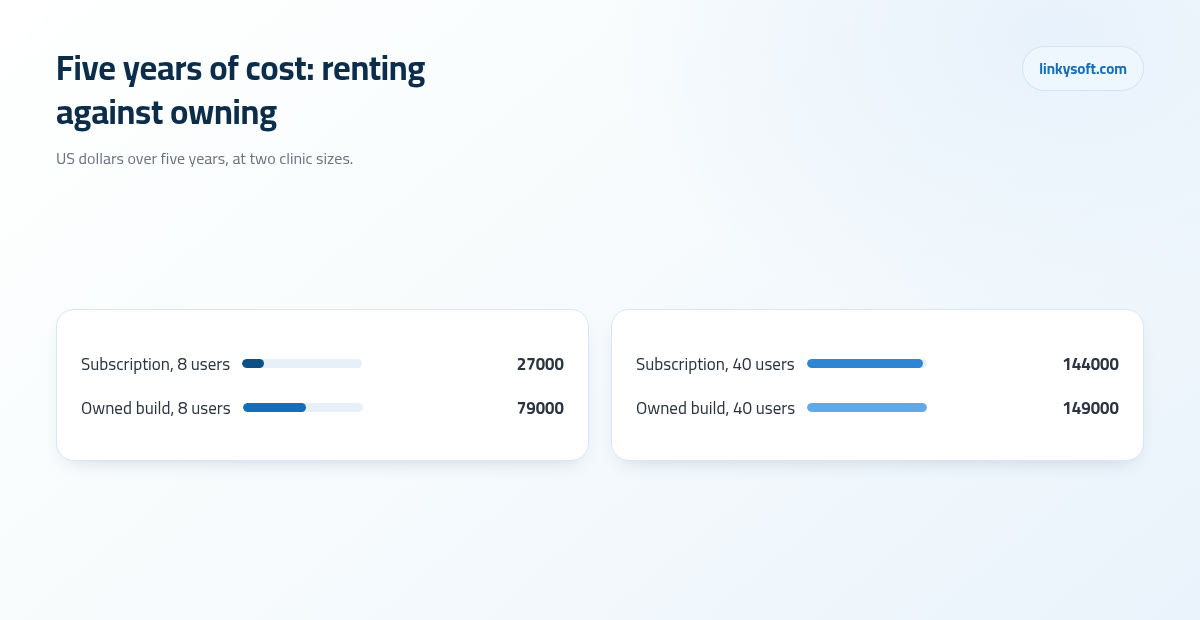
So the crossover is real but it sits further out than most sales conversations imply. In practice it appears somewhere between 30 and 50 daily users, or around year five to seven, and below that a custom build is bought for fit and for ownership rather than for savings. That is a legitimate reason to buy one, but it should be named honestly rather than dressed up as a saving that the spreadsheet does not support.
There are three situations where building wins early, and they are worth stating precisely because they are the only ones that reliably do:
- An unusual workflow that no product supports. A fertility programme, a dialysis rota, an occupational health contract with a large employer: when the way you work is genuinely not the way the products assume, you will spend more fighting a product than building the right thing.
- A group that has to join several clinics and a patient facing app into one place, where the value is in the connection between them and no single product owns all the pieces.
- Data the owner refuses to keep on somebody else's platform, whether for regulatory reasons or as a matter of policy, in which case the decision is made before the arithmetic starts.
If your case is one of those, the build side is custom web application development, and if patients are meant to book and see results on their phones, that is a mobile application alongside it rather than part of the same estimate. It is only fair to say plainly where Linkysoft stands here, since we build both: a four person clinic asking us for a custom system will be told to subscribe to something ready made instead, because we would rather have the conversation now than have it in month nine.
Where the money actually gets wasted
Overspending on clinic software rarely looks like one large mistake, and it almost always looks like four small ones repeated for years. These are the four we see most often.
Paying every month for modules nobody opens. This is comfortably the most common overspend, because modules are easy to add during the sales conversation and nobody ever goes back to check. The fix costs nothing: 90 days after go live, ask the vendor for a login and usage report showing which parts were actually used and by whom, then switch off what the report says is dead. Clinics routinely find they are paying for a marketing module, a second reporting pack and three dormant logins.
Customising a workflow that should have been changed instead. We have seen a clinic pay 4,000 USD to make software reproduce a three step approval that existed only because the form used to be carbon paper. The habit was a consequence of paper, the paper is gone, and the money bought a permanent copy of a problem. Before paying for any customisation, it is worth asking whether the process itself is the thing that needs changing.
Buying for the hospital you might become in five years. Capacity bought early depreciates faster than most clinics grow, and the modules you paid for will have been rewritten twice by the time you need them. Buy for this year and the next one, and let the vendor sell you the rest when it becomes real.
Per user licences for people who log in twice a month, and contracts with no way out. Part time staff, a visiting consultant and the accountant rarely need a full priced login all year, so ask about a read only or occasional user rate before assuming everyone costs the same. Then read the exit terms, because a long contract with no exit clause and no export in a readable format turns a mediocre choice into a four year mediocre choice, and by then your electronic records are the hostage.
Security, backups and the price of one bad day
A system holding medical records carries obligations that a shop's till system does not, and a short list of them is not negotiable at any price point. Every person needs their own login, so the system can attribute every action to a human being. There has to be an access log showing who opened and who changed each file, and when. The data has to be encrypted, both where it is stored and while it travels. Backups have to live somewhere other than the clinic, and somebody has to restore one as a test at least twice a year, because an untested backup is a belief rather than a backup.
The reason this belongs in an article about cost is that the arithmetic of one bad day is easy to follow. A clinic seeing 40 patients a day at an average ticket of 35 USD earns about 1,400 USD in a day, so a single day offline costs roughly 1,400 USD before you count the staff hours spent phoning everybody to reschedule, the appointments that never get rebooked, and the patient who quietly goes elsewhere. Two such days a year comfortably exceed the difference between the cheap vendor and the careful one.
Which is why the cheapest vendor is so often the expensive one. The saving usually comes from the places you cannot see on a demo: no tested restore, no access log worth the name, a backup that runs but has never been opened, and nobody who answers the phone on the morning it all matters. Ask for evidence of the last restore test rather than a promise of backups, and ask what the guaranteed response time is in writing.
Finally, the cheapest protection available to any clinic costs nothing at all. Write a one page paper fallback for the two hours a system can be down: a printed list of tomorrow's appointments kept at reception, a numbered pad for manual receipts, and a rule about what gets entered first once the system returns. Every clinic that has one describes the outage as an inconvenience, and every clinic without one describes it as a disaster. If you want the fuller picture of what protecting patient data involves, our cybersecurity work covers the same ground in more depth.
How to compare two quotes without being fooled
Two quotes for the same clinic can differ by a factor of three and both be honest, because they are quoting different amounts of work. These questions force them onto the same footing, and they should all be asked before signing rather than after:
- How many training hours are included, for how many people, and does that include a session two weeks after go live? The follow up session is where the real questions get asked, and it is usually the first thing dropped from a thin quote.
- What does the support contract promise as a response time, in writing, and what does it cover? "Support included" means nothing on its own, while "four working hours for anything that stops the clinic working" means something you can hold somebody to.
- What does a new report cost after go live? Every clinic wants a report nobody thought of during the demo, and the price of that request ranges from free to several hundred USD depending on the contract you signed.
- Who owns the data, in what format can it be exported, and how long does a full export take? This is the question that decides how expensive year four will be, and the answer should mention ordinary formats like spreadsheets or standard files rather than a printout.
- What does it cost to add one branch, one user, or one integration? Ask for those three prices as numbers, because they are the levers that will move your bill in every year that follows.
- What happens at renewal? Ask whether the per user price is fixed for the term, and what the increase has been for existing customers over the past two or three years. A vendor who answers that question calmly is telling you something useful, and so is one who does not.
Answers to those six turn two incomparable documents into two comparable ones, and it is remarkable how often the cheaper quote stops being the cheaper one by question four.
A budget you can copy, and when the smaller option is the right one
Here are three tiers with numbers you can lift straight into a spreadsheet this afternoon:
- Small clinic, up to about four users: 3,000 to 7,000 USD in year one, then 1,500 to 4,000 a year after that.
- Group practice or polyclinic, 5 to 20 users: 6,000 to 25,000 USD in year one, then 4,000 to 12,000 a year.
- Hospital: 40,000 to 250,000 USD or more in year one, then 15% to 20% of that figure every year to keep it running properly.
Two planning rules go with those tiers and they are worth writing on the same page. Whatever the software line on the quote says, budget 1.5 to 1.9 times that figure for year one, because migration, training, hardware and integrations are real and they always arrive. Then hold back another 10% to 15% for the changes you only discover in month four, when the clinic has been using the system long enough to know what it actually needs, since that money is the difference between fixing the small annoyance and living with it for three years.
The advice we give most often is also the least commercial. The smallest system that genuinely fits this year, chosen carefully, beats the large one bought for a future that may never arrive, because the large one costs more every month while the clinic is still small, and the extra parts are the ones nobody learns. Switching later is normal and survivable, provided the export terms were sorted out at the start, so the decision in front of you is far less permanent than it feels while you are making it.
If you want to see how this plays out in practice, our case studies show the shape of real projects and what they involved. And if you would like a costed comparison of renting against owning for your own clinic, with your own headcount and your own licence prices in it rather than the ranges in this article, the contact page is the place to start, and Linkysoft will tell you plainly if the answer is that you should subscribe to something ready made and spend the difference on a second treatment room.