Choosing a web design company is one of those purchases where the person paying knows the least about what they are buying, which is uncomfortable but entirely fixable. You do not need to understand a line of code to tell a good supplier from a poor one, because the difference shows up long before any code is written: in the questions they ask you, in how a proposal is worded, and in what they are willing to put in writing about dates and ownership. So instead of another polite checklist, this guide gives you the exact questions to ask, the answers that should reassure you, the answers that should make you pause, and the arithmetic to test a quote while you are still sitting at the table rather than three months later.
Before You Call Anyone, Decide What the Website Has to Earn
The question is not which company draws the prettiest home page, because almost all of them can produce something that looks current. Good looking layouts have become cheap and widely available, which is genuinely good news for buyers. The harder question, and the one that decides whether the money was well spent, is which company can build the thing that brings in more customers than it costs.
So before you email anybody, write one sentence on a piece of paper: the job this website has to do. That might be booked appointments, or phone calls from people who live within ten miles of you, or online orders, or enquiries from businesses that can actually afford your prices. This sounds like a small exercise and it changes everything, because a company that hears a clear job quotes very differently from one that hears make it look modern. The first is being asked to solve a problem and can price the solution, while the second is being asked to decorate and will price the decoration.
Then do the arithmetic in plain numbers, because it sets your budget far better than taste does. Take a dental clinic where a new patient is worth roughly US$400 in profit, and where about one enquiry in three turns into a booking. Ten enquiries a month is three or four new patients, which is somewhere around US$1,200 to US$1,600 a month, so a US$6,000 build pays for itself in about four to five months and comfortably covers its own running costs after that. That only holds if people actually find the site, though, which is the honest condition nobody mentions: if nothing is bringing visitors to the page, part of that budget belongs to marketing rather than to design.
If you genuinely cannot answer what the site should earn, you are not ready to buy yet, and that is a respectable place to stand rather than an embarrassing one. A good company will help you answer it during the first conversation instead of quietly selling around it, because the design and build work itself becomes far easier to scope once everyone in the room knows which number the site is chasing.
The Four Kinds of Company You Will Meet, and Who Each One Actually Suits
Almost every supplier you speak to falls into one of four groups, and knowing which one you are talking to explains most of the price difference before anybody quotes anything.
- The solo freelancer is one person doing design and build, usually charging US$15 to US$60 an hour. You talk directly to the person doing the work, decisions happen in minutes rather than in meetings, and there is no account manager sitting in the middle adding cost.
- The small studio of three to eight people charges more like US$40 to US$100 an hour and gives you a designer, a developer and somebody who answers the phone when the developer is deep in something, which suits a custom built site with a content manager, meaning a screen you log in to yourself to change your own text and photos without ringing anybody, or a modest online shop.
- The full service agency charges US$90 to US$200 an hour and earns it when the website is one moving part of a marketing operation, with strategy, brand work, copywriting and campaigns running alongside.
- The template shop buys a ready made design, fills it with your words and photos, and hands it over for US$500 to US$2,500, which is an honest and useful service as long as everyone is clear that is what it is.
Here is the matching rule we would give a friend. A barber, a single room clinic, a new bakery or a two van plumbing business is usually best served by a good freelancer or a well executed template build at US$1,200 to US$2,500, and paying an agency US$9,000 for that same shop window is a waste of the owner's money. The site does not need to be original to work; it needs to load fast on a phone, say clearly what you do, and make it obvious how to contact you.
The cheapest route does carry one real risk, and it is worth naming plainly rather than pretending otherwise: a single person is a single point of failure. So ask the freelancer directly what happens to your site if they are ill for three weeks, and listen for a concrete answer such as a named colleague who covers, a written handover, and the code kept somewhere you can reach without them. A vague reassurance here is the cheapest warning you will ever get.
There is also a point where you have outgrown a website altogether without realising it. If you need appointments booked against staff calendars, members logging in to see their own records, a dashboard that reports on something, or stock levels that must stay in step with an accounting system, then you are describing a piece of software rather than a set of pages, and hiring a website company for it is how projects go badly. Worth saying too: a company that can build a phone app or an automated assistant is not automatically better at websites, since those are genuinely different crafts, so treat work on phone apps as evidence of capability in that area and nothing more.
Why One Quote Says US$2,000 and the Next Says US$12,000 for the Same Website
The first thing to understand is that a quote prices a scope, not a level of quality. Two numbers that look like they cover the same job are almost always covering two different jobs wearing the same name, which is why comparing headline figures alone tells you nothing useful.
What is quietly missing from the cheap number is usually the same short list every time: writing the words, photography, moving your old content across, connecting payments or a booking system, training you to use the thing afterwards, testing on real phones rather than in a browser window, and any support at all once the site is live. None of those are luxuries, so they do not disappear when they are left off a quote. They simply reappear later as an invoice, or as your own unpaid evenings.
You can test any quote at the table with one piece of arithmetic. Divide the number by a fair hourly rate of US$40 to US$100 and ask honestly whether the resulting hours could build what the document describes. A US$2,000 quote at US$75 an hour is about 26 hours of work, which is roughly three working days, so it can only mean a ready made template lightly adjusted, and that is fine as long as you know it. A US$7,500 quote at the same rate is about 100 hours, or two and a half weeks of one person's full attention, which is a believable number for a custom designed site of moderate size.
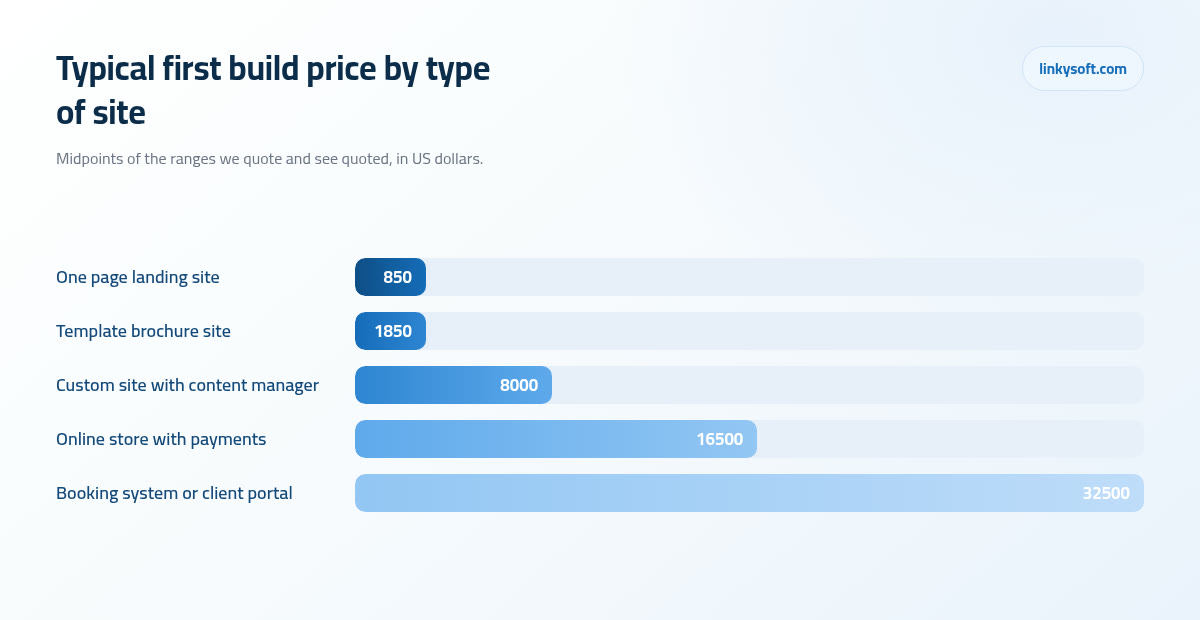
For reference, these are the bands we work with, and local markets shift every one of them, sometimes by half, so treat them as a way to spot a number that cannot possibly work rather than as a price list.
- A one page landing site, built around a single service or campaign: US$500 to US$1,200.
- A template based brochure site of five to eight pages: US$1,200 to US$2,500.
- A custom designed site of ten to twenty pages with a content manager, the screen you log in to so you can change text and photos yourself: US$4,000 to US$12,000.
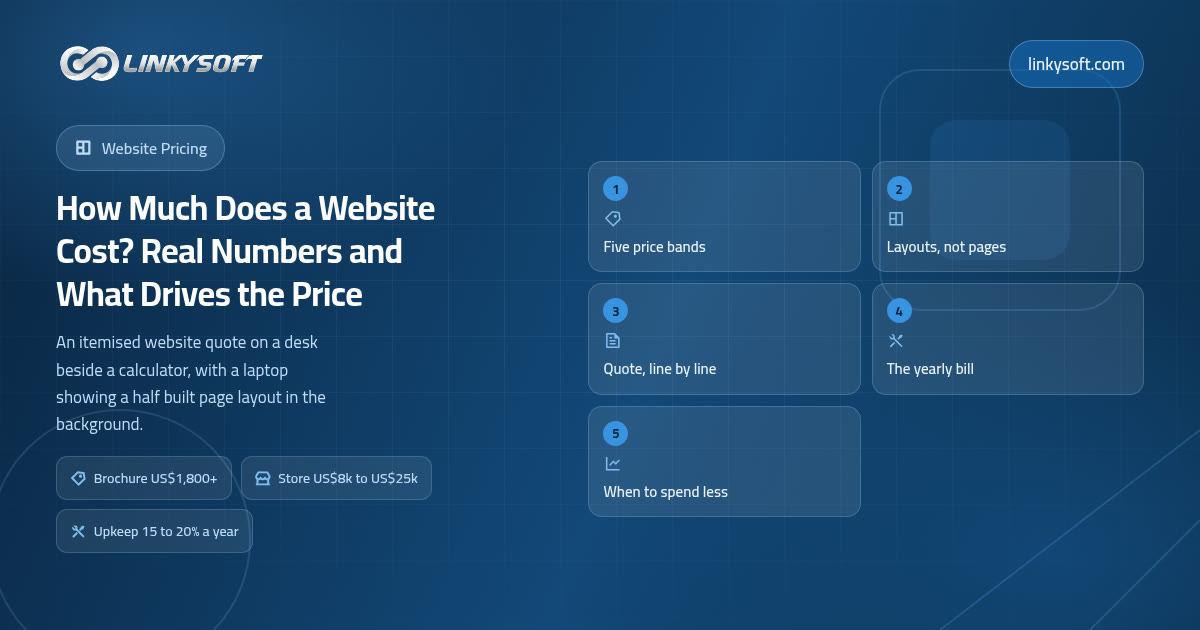
- An online store with payments and shipping: US$8,000 to US$25,000.
- A booking system or a customer portal: US$20,000 to US$45,000.
One more piece of reality about size: most small businesses launch perfectly well with five to nine pages, and each extra page typically adds US$150 to US$400 to the price. A thirty page plan almost always turns into twenty pages of placeholder text that is still sitting there empty a year later, so fewer pages written properly will beat more pages written never.
We quote these projects at Linkysoft, so we will say the awkward part out loud: on a fair number of the enquiries that reach us, the right advice is a smaller build than the one being asked for, and we would rather say that in week one than deliver something oversized and watch it sit unused. If you want the full breakdown of where money goes inside a build, we have written separately about what a website costs and which line items are worth defending.
The Questions That Reveal a Good Company, and the Answers That Should Worry You
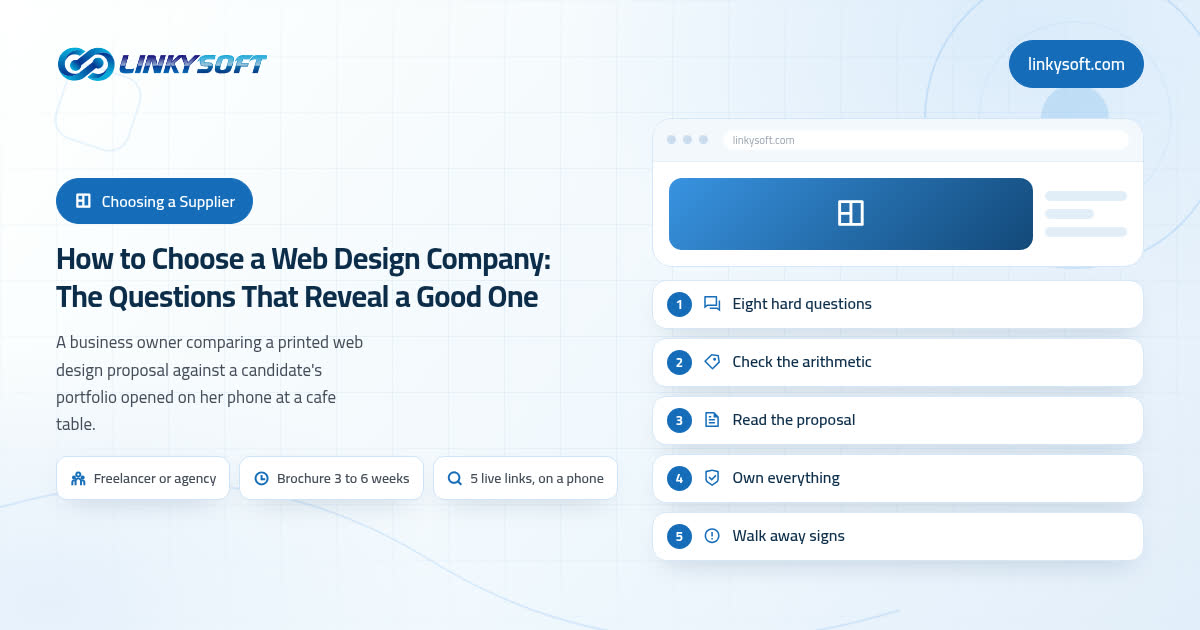
These eight questions do more work than any portfolio review, because they are hard to answer well without actually running a decent business. Ask them in a meeting or over email, and pay as much attention to how quickly an answer arrives as to what it says.
Who exactly will do the work, and can I speak to them once before I sign?
The answer you want is two names and a short conversation: this designer, that developer, and yes, you can have twenty minutes with them. The answer that should worry you is we have a team, because that phrase very often means the work will be passed to somebody cheaper you will never meet, in a time zone that makes questions slow.
Can you send five sites you built in the last eighteen months that are still live today?
You want five real links you can click, not screenshots and not a slideshow, since anyone can design a beautiful picture of a website. Open each one on your own phone and count what you find, because if two or more are offline, visibly broken or painfully slow to load, that is a fair preview of what your site will look like in two years. Published write ups of finished projects help here too, which is why we keep our own project write ups public rather than describing them vaguely.
What is not included in this price?
A good company answers this immediately and in detail, listing the things you will need to supply or buy separately, because they have had the awkward conversation before and would rather have it now. A weak one says everything is included, which is never true of anything and simply moves the conversation to an invoice later.
Who writes the words and finds the photos?
This is the single question that decides whether you launch in ten weeks or ten months, so do not let it pass with a shrug. The answer you want is specific: either they write and source, at a stated price, or you do, by a stated date. The answer that should worry you is that we will sort it out as we go.
How many rounds of design changes are included, and what does a change cost after that?
Two or three rounds at the design stage is the fair market norm, with further rounds billed at the hourly rate, and a company that states this clearly is being straight with you rather than mean. Unlimited revisions sounds generous and usually means one of two things: the price was padded upward to cover the risk, or nobody has agreed what a round actually is, which ends in a disagreement you cannot win.
What happens when we disagree about a design?
The answer you want describes a process tied to the goal of the site, something like we will show you two directions, explain which one we think serves booked appointments better and why, and you decide with that in front of you. The answer that should worry you is that the client is always right, because that is how a site ends up designed by whoever spoke loudest in the meeting rather than by what works.
What is your reply time when something breaks, and who do I call at nine at night?
Ask for numbers and get them written down: a reply the same working day for normal messages, and four to twenty four hours for a site that is down or has stopped taking orders. Ask for a named person rather than a shared inbox, because a shared inbox is where urgent messages go to be nobody's job.
Can I speak to a client whose project went badly?
Every company that has been running for a few years has at least one project that went sideways, so a claim that they all went perfectly is either inexperience or a poor memory. The willingness to answer this honestly, ideally with the story of what went wrong and what they changed afterwards, tells you more about how they will treat you in a difficult week than any award badge on their footer.
Read the Proposal Like a Contract, Because in a Month It Becomes One
Whatever the proposal says is what you have agreed to, so read it the way you would read a lease. It should name a page count, list the features by name, state how many rounds of revisions are included, give a launch date, and say what happens if either side misses a deadline. A document that does none of that is a brochure, not an agreement, and you have no way to hold anyone to a brochure.
Payment should be staged so that both sides carry some risk. Something like 30 percent at signing, 40 percent at design approval and 30 percent at launch works well, and a 40 / 40 / 20 split is equally fair. Paying 100 percent up front leaves you with nothing held back if the work slows down, while a supplier asking for no deposit at all is not being generous: a project with no money committed to it quietly slides to the back of the queue behind the ones that have been paid for.
Two phrases in a proposal deserve a red pen every time, and they are and similar and to be discussed. Both sound harmless and both do the same thing, which is to move a cost out of the quote you are comparing and into an invoice you have not seen yet. Ask for either phrase to be replaced with a number or a name before you sign.
Finally, insist that the scope is written as things you can point at and check. A working booking form that sends a confirmation email to the customer and to reception is something you can test on launch day, whereas modern responsive design is an opinion, and you cannot hold anyone to an opinion.
Who Owns the Website on the Day You Walk Away
One day, maybe in four years, you will change supplier. That day is when you find out what you actually own, so settle it now while everybody is friendly. There are five things to check, and all five should be yours: the domain name registered in your own name and to your own email address, the hosting account billed to your card, the code stored in a repository you can log in to, a repository being simply the online filing cabinet that holds the site's files and every earlier version of them, the top level administrator account of the content system, and the exported design files.
The problem this prevents is called lock in, which in plain terms means being unable to leave without starting again. If a company built your site on a system only they can edit, then changing supplier does not mean moving your website, it means rebuilding it, and recreating work you already paid for once typically costs US$500 to US$2,000 on top of whatever the new site costs. That is a bill for standing still.
The fix takes one sentence in the contract, confirming that on final payment the domain, hosting access, code, administrator accounts and design files transfer to you. Ask for it before signing rather than after, because it is an easy yes at the start and an awkward conversation at the end. A company worth hiring hands the keys over without any drama at all, since their plan for keeping you is doing good work rather than holding your domain name hostage.
Three Things a Cheap Build Quietly Skips: Speed, Phones and Being Found
Speed is the first casualty, and it is not a technical nicety. The target worth holding anyone to is that the main content of a page appears in under about 2.5 seconds on a mid range phone using mobile data, not on a fast office connection. In the rebuilds we do, taking a home page from around six seconds down to around two usually lifts the share of visitors who go on to look at a second page by something between a fifth and a third, which is a large gain from work that is invisible in a screenshot.
Phones are the second. For clinics, restaurants, trades and shops, we typically see 60 to 80 percent of all visits arriving from a phone, so the phone version is the real website and the laptop version is the afterthought. Which leads to a piece of homework worth doing before your first meeting: open every candidate's portfolio on your own phone, on mobile data, and see how it feels. Designers show their work on big screens for obvious reasons, and it is remarkable how often that flatters something that is uncomfortable to use in a hand.
Being found is the third. Basic search work is less mysterious than it is made to sound: readable page titles that say what the page is, real text on the page rather than words trapped inside images, fast loading, and a properly filled in business listing so you appear on the map. That much should be part of any competent build. Anything more ambitious belongs to ongoing marketing work and should be priced separately, and anybody guaranteeing you first place on Google is selling something they have no way to deliver, because nobody controls those results.
Then there are the small items that get trimmed from a cheap quote and cost you later: measurement, so you can actually see how many enquiries the site produced; a contact form that has been tested and genuinely delivers mail rather than dropping it into a spam folder; and text that is large enough and contrasted enough for a customer of seventy to read comfortably. None of those are expensive to include and all of them are expensive to add afterwards.
How Long It Really Takes, and Who Causes the Delay
The honest ranges are these. A brochure site takes three to six weeks, a custom designed site with a content manager takes eight to fourteen weeks, and an online store takes ten to twenty. Anything promising a custom site in two weeks is either using a template, which is fine if said out loud, or is about to miss the date.
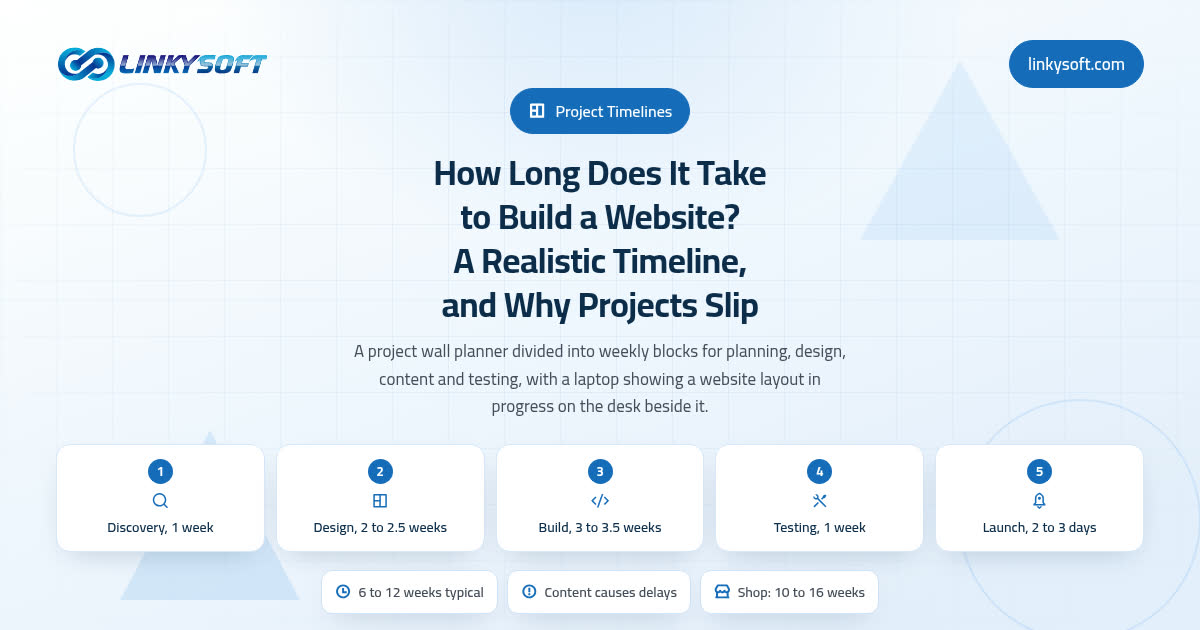
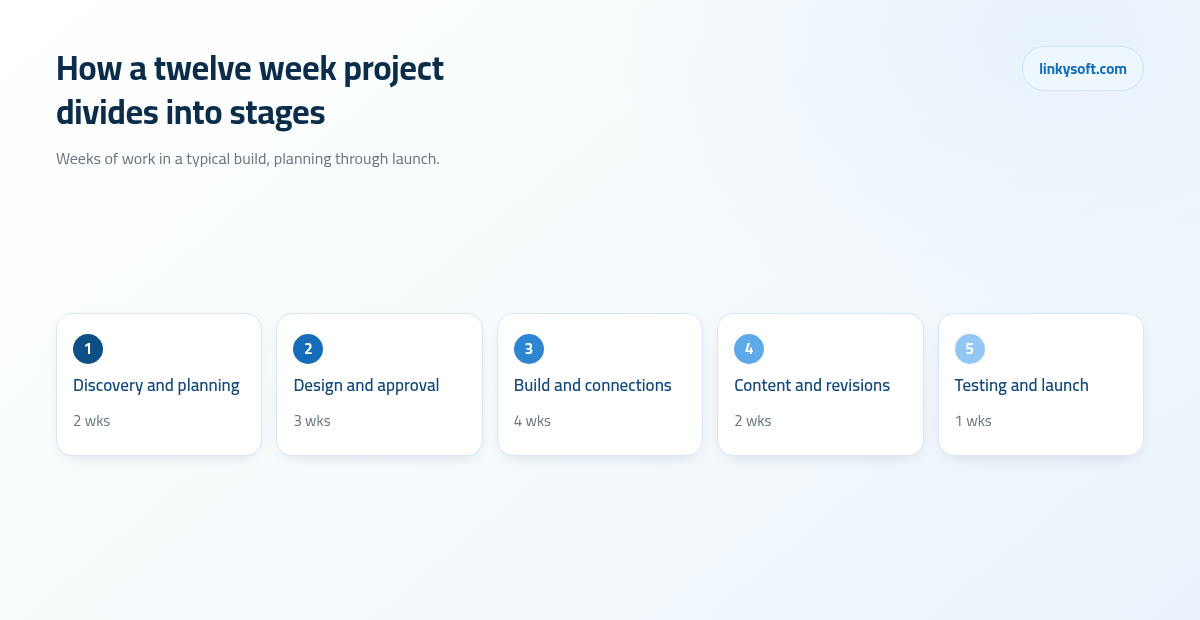
Inside a twelve week project the weeks usually divide up as two for discovery and planning, three for design and approval, four for building and connecting things such as payments or a calendar, two for content and revisions, and one for testing and launch. Knowing that split is what lets you hold a company to a schedule, because you can ask in week six whether design was approved on time instead of finding out in week eleven that nothing has moved.
Which brings us to the uncomfortable truth, said kindly. In most projects we run, the longest wait is not for development at all: it is for the client's text, photographs and account logins. And a two week wait for content does not push launch by two weeks, it pushes it by more, because the team that was holding those days for you has been scheduled onto other work in the gap and cannot simply unbook it.
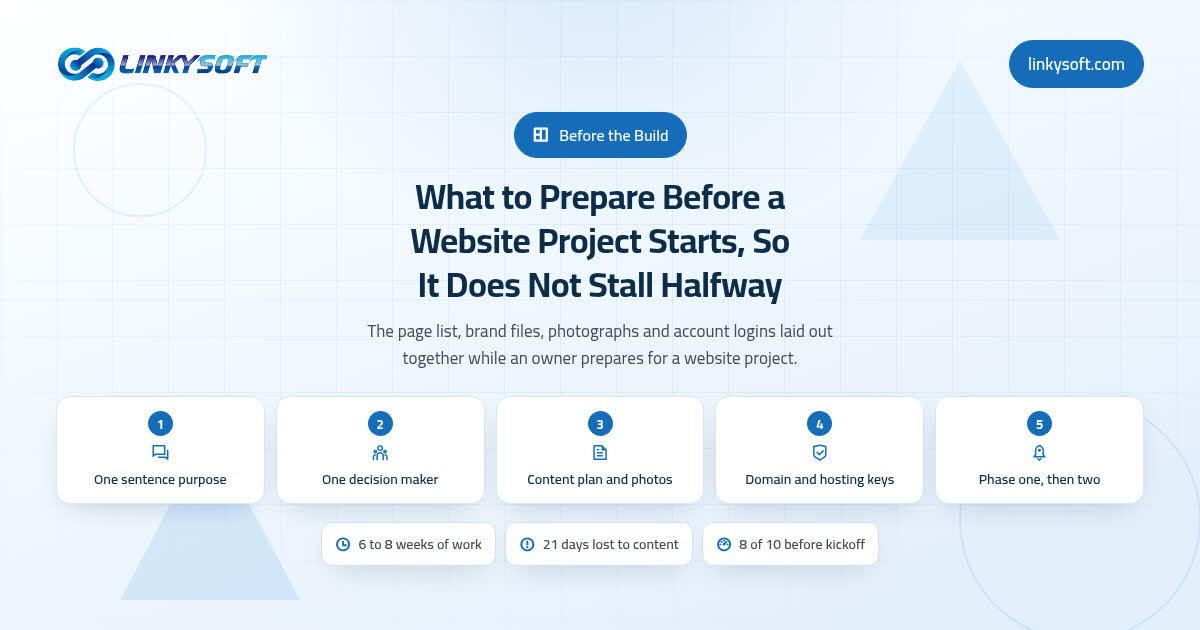
So prepare before design begins rather than during it. As a rough measure, set aside six to ten hours of your own time for every five pages to gather the words, dig out the photos and find the passwords, or pay someone US$80 to US$200 a page to write it for you. Doing that in the two weeks before the project starts is the single cheapest thing you can do to protect your own launch date.
The Bills That Start on Launch Day
A website is not a one off purchase, and any supplier who lets you believe it is has set you up for an unpleasant surprise. The domain name costs US$10 to US$20 a year. Hosting runs US$10 to US$60 a month for a normal business site and US$30 to US$300 a month for a busy store, since traffic and orders both cost computing power. On top of that sit the updates.
The rule of thumb worth remembering is that maintenance runs at 5 to 15 percent of the build cost per year, so a US$6,000 site costs roughly US$300 to US$900 a year to keep patched, backed up, monitored and working. That is not a subscription for nothing: it is the difference between a site that still works in three years and one that quietly breaks and takes your contact form with it.
Security deserves one plain paragraph, because the picture in most people's heads is wrong. Small business sites are almost never broken into by somebody targeting them personally; they are broken into by automated programs that scan millions of sites looking for out of date add ons with known holes in them. That means updates are more or less the entire defence, and a supplier who keeps things current is doing the security work, which is also where more serious protection starts if you handle customer records or take payments yourself.
Two overcharges to watch for. The first is being billed around US$150 a year for a security certificate, the padlock in the address bar, which most hosts now provide free as standard. The second is a support retainer that buys you no actual hours: if you are paying monthly, the agreement should say what you get for it, whether that is updates, backups, monitoring or a number of hours for small changes. We have written more about hosting and running costs if you want the detail before you sign anything.
Test Them With One Small Paid Job Before You Hand Over the Whole Project
Here is the advice that saves the most money and almost nobody follows. Before committing to the full build, buy one small piece of paid work: a discovery session or a single page design, typically US$500 to US$1,500 over one to two weeks, and ask whether that fee is credited against the full project, because it very often is.
What you are really buying is evidence rather than a deliverable. You find out how they communicate when something is unclear, whether they hit a small deadline without being chased, whether the invoice matches what was quoted, and above all whether they ask about your customers or only about your colour preferences. A designer who spends the first meeting asking who actually calls you and why is thinking about the job the site has to do, while one who leads with fonts is thinking about the picture.
If you are torn between two finalists, give both the same brief and the same deadline, then judge them mostly on the questions they asked rather than on the picture they produced. The prettier submission is easy to admire, but the better questions predict the better project by a wide margin.
At Linkysoft we would honestly rather start a new client on a small paid step than sell a large project they are not yet ready for, because a build that begins with a clear job and an agreed scope goes well, and one that begins with enthusiasm alone very often does not. The same reasoning applies to the clever additions people ask about early on, such as an automated assistant answering the questions customers repeat all day, which is a good second year project once you know what those questions are, and a poor first build when nobody has any idea yet.
Warning Signs That Are Worth Walking Away From
None of these are automatically fatal on their own, but two or more together is a pattern rather than bad luck.
- A full quote arrives in under an hour with no questions asked about your business, which means they have priced a template and not your problem.
- A guarantee of first place on Google, or of a specific number of customers, since neither is within anyone's power to promise.
- No live links to recent work, or links that turn out to be dead, slow or clearly unmaintained when you open them on your phone.
- Pressure to sign today because a discount expires tonight, which is a sales tactic rather than a pricing decision.
- Refusal to write the page count, the number of revision rounds and the ownership terms into the proposal.
- The domain being registered in their name rather than yours, offered as a convenience to save you the trouble.
- A price so far below every other quote that the arithmetic simply cannot work, because somebody always pays that difference eventually, and it is usually you.
How We Would Choose If We Were Sitting on Your Side of the Table
The whole decision comes down to three moves. Write down what the site has to earn before you speak to anyone, so every conversation has a number in it. Ask the five hardest questions from this article, particularly who does the work, what is excluded, who writes the words, and what happens when something breaks at nine at night. Then buy one small paid step before the big one, and let their behaviour on that small job tell you what a six month relationship would feel like.
And we will repeat the unfashionable part, because it matters more than anything else here: the smaller supplier is very often the correct answer. The aim is a website that pays for itself and keeps working, not the most impressive proposal document in the pile, and plenty of excellent small businesses are being served perfectly by a US$2,000 site that loads quickly and answers the phone. If you are weighing that decision now, it is worth reading how others approached planning a redesign before committing to a full rebuild.
If you would like a candid second opinion on a quote you have already received, or a brief you want turned into a realistic scope and date, send it to us. Linkysoft will tell you where a number looks fair, where it looks thin, and when the smaller option is the one we would take ourselves, so get in touch or read more of how we approach design and build work before you decide.