If you are sitting in front of an empty document with a heading that says About Us and nothing underneath it, you are in the majority, and the problem is almost never that you cannot write. It is that nobody has handed you the shape a web page is supposed to take, so you are being asked to invent the structure and fill it at the same time, which is two jobs pretending to be one. Most advice for this stops at know your audience and write for humans, which is true and completely useless at nine o'clock on a Tuesday when the site is due on Friday. So this guide hands over the working parts instead: where to find the words you already own, the order to write the pages in, how many words each page actually needs, a five block skeleton that turns a blank screen into a draft, a recording method that turns a page around in about 95 minutes once those questions are collected, and the plain arithmetic of what a copywriter costs set against what your own time is worth.
You Already Know More About Your Business Than Any Writer Does
In our experience the most common reason a website launches late is missing text, not design and not code. The building work runs on a fairly predictable clock, so a small business site that should take four weeks quietly stretches to eight or ten while everyone waits on the words, and the design that was signed off in March is still showing filler text in June. Nothing else in a project has that much power to stall it, because a developer can work around a missing photograph but cannot invent your prices, your process or your guarantee.
The reassuring part is that what a professional writer sells is not knowledge of your business, since they have none of it on the day they start. What they sell is structure and compression: knowing which question belongs first, how long a section should run, and how to say in nine words what you would naturally say in forty. Structure can be borrowed, which is the entire point of this article, whereas knowledge cannot be borrowed at all, and you are the one who already holds it.
Consider what is sitting in your head that a writer would have to go and dig out of you. You know the objection you hear every single week, whether that is why are you dearer than the workshop down the road, or how do I know you will actually turn up. You know the three questions people ask before they hand over any money, and you know the real reason your last customer chose you rather than the cheaper option, because customers usually say so out loud. A writer's first move is to interview you until those things come out, which means a fair share of what you would be paying for is a conversation you can have with your own phone.
What you should leave this article with is a repeatable method rather than a burst of inspiration, target lengths for every kind of page, and an honest view of the point where paying somebody becomes the smarter move. At Linkysoft we build sites for clients in quite different markets and languages, and the pattern holds everywhere: the projects that ship on time are the ones where the owner started collecting words in week one instead of waiting until the design was finished.
Collect the Words You Already Have Before You Invent New Ones
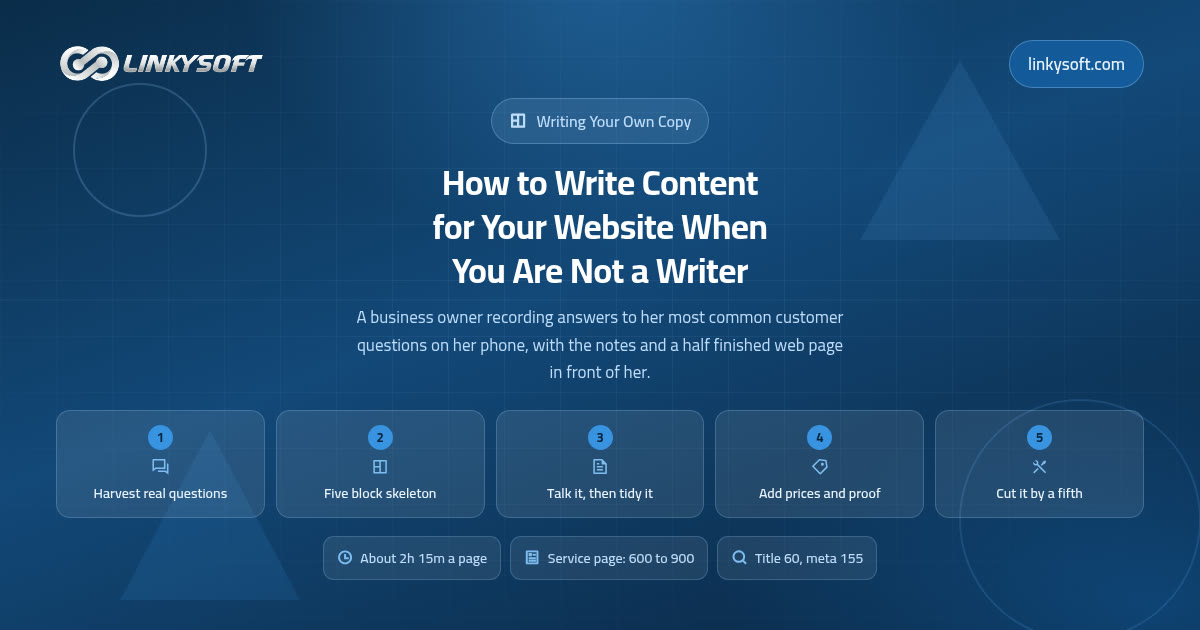
Begin with a task that involves no writing at all. Open your last 30 to 50 enquiry emails, WhatsApp messages and quote requests, read them in order, and write down every question that appears more than twice. Do not summarise them and do not tidy them up, just list them as they came in. It takes roughly 45 minutes, and because you do it once for the whole site rather than once for every page, it is the highest value 45 minutes in the whole project.
What we see happen almost every time is that 6 to 10 recurring questions cover about 80 per cent of everything people ask. Those questions are not background research, they are the headings of your website, already written for you by the people who pay you. When a page carries the same question a visitor arrived with, they keep reading, because it is immediately obvious that somebody has stood where they are standing.
Copy the customer's exact words rather than the trade term, since those are two different languages. A patient writes my back tooth hurts, while the clinic's old website said endodontic assessment, and only one of those is ever typed into a search box. Only one of them makes a nervous person feel understood, either, so put the customer's phrase in the heading and keep your professional term for the sentence underneath, where it belongs and where it reassures rather than blocks. Working from the questions customers actually ask gets you to good headings faster than any brainstorm ever will.
Then add three more lists to the same document while you are still in the flow: three reasons people bought from you, three reasons people walked away, and the two things people always ask about price. That is the whole exercise. One single page of raw supply, feeding every other page on the site, which means you never again start from a blank screen, only ever from your own material.
Write the Pages in the Order That Earns Money, Not the Order of the Menu
Most owners start with the home page because it sits first in the menu, and that is precisely why they end up rewriting it five times. Work in this order instead: one service page first, then the remaining service pages, then your proof or case studies, then about, then contact, and the home page last of all.
The home page goes last because it is a summary of everything else, so writing it first means guessing at what you are about to summarise, and guesses have to be redone once the real pages exist. Leave it until the end and it becomes an assembly job that takes an hour, built from lines you have already written and already like.
Keep the scope honest while you are at it. A small business needs 6 to 10 pages at launch, and a plan with more than about 12 pages in it usually goes live with half of them unfinished, because the energy runs out somewhere around page seven and the empty ones then sit there quietly undermining the good ones. Fewer pages, each of them complete, beats a large menu with gaps in it every time.
There is a compounding effect here that makes the first page worth the effort. Write one service page properly and you have learned the pattern, so the second and third pages go faster than the first, and by the fourth you are mostly swapping in different facts rather than working anything out. That is also why words and layout should be decided together rather than one after the other: when we take on design and build work, the page structure is shaped around the questions the words have to answer, so nobody ends up pouring 900 words into a design that was drawn for 300.
How Many Words Each Page Actually Needs
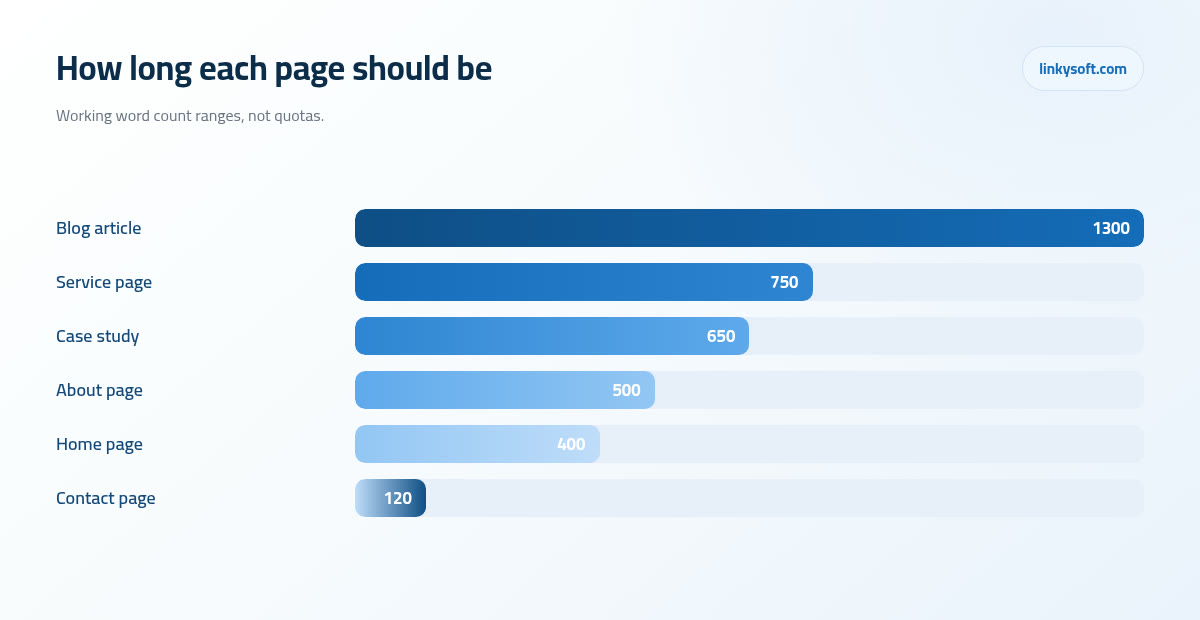
How much should I write is the question that stops more owners than any other, largely because the honest answer usually sounds evasive. So here are the working targets we use when planning a small business site, and you can hold any page against them without a judgement call: a home page of 300 to 500 words, a service page of 600 to 900, an about page of 400 to 600, a case study of 500 to 800, a contact page of 80 to 160, and a blog article of 1,100 to 1,500.
There is a floor underneath those numbers and it matters more than the target does. A service page under roughly 250 words rarely answers enough to earn an enquiry, because in 250 words you can say what you do but not what it costs, how long it takes, what happens first, or why anyone should believe you. It also gives a search engine very little to understand the page by, so a thin page loses on both counts at once, with the human reader and with the machine that decides whether to send them.
The ceiling is just as real, though it disguises itself as thoroughness. A 2,500 word service page is usually three separate services fighting each other inside one document, and the fix is not to trim it but to split it, which helps all three at once: each page then covers one subject properly, reads faster, and stands a chance of ranking for its own thing instead of diluting one page across three.
Treat all of this as a sanity check rather than a quota, because these are working targets and not rules. If your page answers the question completely in 400 words, leave it at 400 words and go and do something more useful with your evening, since padding a good page out to hit a number makes it worse in every way that counts.
The Five Block Skeleton That Turns a Blank Page Into a First Draft
Almost every service page that works, in any industry and any country, is carrying the same five blocks in roughly the same order. Once you can see them, the blank page stops being a blank page and becomes five small questions, and small questions are easy to answer even when you are tired.
- Who this is for, in two lines. Name the customer, the problem and the place, so a stranger knows within seconds whether the page is for them. Somebody who is not your customer should be able to leave quickly, which is a feature and not a loss.
- How it works, in 3 to 5 numbered steps. Sequence is the easiest thing in the world to write because you live it every day, and it is also the thing buyers most want to see, since the question behind almost every enquiry is what happens after I call you.
- What it costs and how long it takes. A range is enough, and being direct about it costs you nothing: in practice hiding the price does not increase enquiries, it increases wasted phone calls and what the trade calls unqualified leads, meaning people who ring up, discover that you are well outside their budget and hang up.
- Proof. One named example, one number and one photograph of real work will carry more weight than a page of praise, because all three can be checked and praise cannot.
- One next step. A single action, written as an instruction, placed once near the top and once at the bottom. Five competing buttons is not five chances, it is one decision the reader now has to make on your behalf, and tired people do not make decisions.
Here is what that looks like filled in for something ordinary, a dental clinic in Nairobi writing its root canal page, with the real numbers left in rather than politely withheld.
- Who this is for. Adults in Nairobi with a painful back tooth who would rather have it dealt with in one visit than in three.
- How it works. You call or send a photo, you are seen within 48 hours, we take an X ray and quote before anything starts, then we treat in a single 90 minute appointment and review you a week later.
- What it costs and how long it takes. A single root treatment is 8,000 to 15,000 Kenyan shillings depending on which tooth it is, and the appointment itself takes about 90 minutes.
- Proof. 412 root treatments here last year, nine in ten of them finished in one visit, with a photograph of our actual surgery rather than a stock image of somebody else's.
- One next step. A single line: call this number, or send a photo of the tooth on WhatsApp and you will have a price back the same day.
A metal workshop working through the same five blocks would fill them with completely different facts and end up with an equally usable page, which is rather the point, because the shape is borrowed and only the content has to be yours.
Talk the Page Instead of Typing It, Then Tidy the Transcript
The reason writing feels so slow is arithmetic rather than talent. Most people speak at 120 to 150 words a minute and type at 30 to 40, so fifteen minutes of talking produces 1,800 to 2,250 words of raw material, which a whole evening at a keyboard will not match. That transcript edits down comfortably into a 700 word service page, and you did the hard part standing in your own workshop with a cup of tea.
The method is deliberately unglamorous. Put the five block questions on the table where you can see them, press record on your phone, and answer each one out loud as though a customer had just asked it across the counter. Do not perform and do not restart when you stumble, because stumbles disappear in the edit and stiffness does not. Fifteen minutes of that per page is the whole recording stage.
Then transcribe it, using your phone's own voice notes app or any free transcription tool, and edit by deleting rather than rewriting. This is the part people get wrong: the draft is already inside the transcript, so your job is to take away the repetitions and the false starts and put headings on what is left, not to start again in proper writing mode. Rewriting from scratch is how the life gets ironed out of it.
What makes this work better than writing is that it keeps your natural voice, and your voice is the one thing a competitor cannot copy and a stranger cannot fake. It is also why the pages sound like the person the customer eventually meets, which quietly reduces the number of enquiries that go nowhere.
Artificial intelligence belongs in this same workflow, so let us be honest about where it helps. A model is genuinely good at taking a messy transcript and giving it an order, suggesting headings, and shortening a rambling paragraph without losing its meaning, and that is real time saved. It is genuinely bad at knowing your prices, your local rules, your suppliers and your customers, so it will fill those gaps with plausible invention if you let it. Paste your own words in and ask it to organise them, never ask it for facts, and treat anything it adds that you did not say as something to be deleted. We take the same line when we build AI systems for clients: the machine handles the shaping, the human supplies the truth.
There is one test that catches generic writing before it goes live. Swap your business name for a competitor's and read the page again, and if it still reads perfectly true, the page is not doing its job, because it is describing an industry rather than describing you.
The First Two Lines Decide Whether Anyone Reads the Rest
Visitors give a page somewhere between 10 and 20 seconds before deciding whether to stay, and in that time they read roughly the first 50 to 80 words plus the headings. Everything else on the page is only read by people the top of the page has already convinced, which means a promise that only becomes clear in paragraph four is a promise nobody reads. Put the whole offer at the top and let the detail follow.
The headline shape that works is not clever, it is complete: what you do, for whom, and either the specific outcome or the place. So a line like Quality Solutions for Modern Business becomes Same day laptop repairs for offices in central Manchester, most machines back the next morning. The first tells a reader nothing they can act on, while the second answers what, who, where and how fast in one breath, and a reader who wanted something else has been let off politely.
Some openers should be deleted the moment you see them, starting with welcome to our website, which spends your most valuable sentence on a greeting. One word headings belong in the same bin, so Solutions, Excellence and Innovation all go, because a heading is a signpost and none of those points anywhere.
There is a test for this that takes a minute. Read only your headings, top to bottom, ignoring every paragraph, and see whether they summarise the page on their own. If they do, a skimming reader gets the whole story for free and will often read the detail anyway. If they do not, your headings are decoration, and rewriting them is usually the single fastest improvement you can make to a page. It is worth looking at how other pages handle their opening headlines before you settle on yours.
Swap Adjectives for Proof
Here is the rule in one line: every adjective is a claim you have not proved yet. Fast delivery proves nothing, whereas most orders leave the same day and nine in ten arrive within 48 hours is the same idea with the evidence attached, and it is no harder to write once you know your own numbers.
The minimum we look for on any service page is three specifics: a price or a range, a timescale, and one named example. Pages carrying all three consistently produce better qualified enquiries than pages full of praise, because the reader has already answered most of their own questions and is contacting you to buy rather than to find out whether they can afford you. That difference shows up in your week rather than in a report.
New businesses always raise the same objection here, which is that they have no testimonials yet, and the answer is that specificity itself reads as proof. Use process detail, quantities, years, counts, guarantees and photographs of your actual work, so twelve years on the tools, roughly 40 jobs a month, a two year guarantee in writing, and three photographs of a real installation will do more than a borrowed quote ever would. Nothing there requires a single customer to say anything.
It also helps to separate a review from evidence, because they are not the same currency. A review is somebody's opinion and a reader discounts it automatically, while evidence is a fact they can picture, which is why one sentence of numbers usually outperforms three glowing quotes with no detail in them. Our own case studies are built on that principle, so they are worth a look purely as a model for what a page assembled out of evidence looks like on the screen.
Writing So Search Engines Understand You Without Writing for Them
One topic per page, in plain terms. A page trying to cover three services ranks for none of them, and it confuses the buyer as well, since they arrived with one problem and are now being asked to sort through three. Split it and both audiences are better served at once.
Use the words your customers actually type rather than the words your industry prefers. If people search for a dentist in Nairobi then the page should say a dentist in Nairobi, not dental care solutions provider, because nobody has ever typed that phrase in their life. This is where the list you harvested in the second step pays for itself, since it is already written in customer language.
The main phrase belongs in three places: the page title, the first heading, and once or twice in the body where it falls naturally. That is genuinely all. Repeating it fifteen times reads badly to a person, helps nothing with a search engine, and makes a page sound like it was written by somebody counting rather than explaining.
Two things are entirely within your control and worth writing by hand instead of leaving to chance. The clickable title that shows in search results runs to about 60 characters, and the description underneath it to about 155, which is roughly one short sentence and one longer one. Those two lines are your advert in the results page, so they deserve five minutes each rather than whatever the system generated.
Say the rest plainly: no amount of search work rescues a page that does not answer the question, so the writing comes first and the optimisation is a finishing pass over the top of it. Once the pages are honest and specific, the ongoing side, which is digital marketing work like publishing regularly and earning links, meaning other websites choosing to point at yours, which search engines read as a vote of confidence, has something worth promoting. If you want the longer version of that, it is worth reading about keywords and search visibility separately, because it is a different discipline from writing.
The 30 Minute Edit That Anyone Can Do
Read the whole page out loud, and rewrite anything you stumble over, because a sentence you cannot say is a sentence nobody can comfortably read. Your mouth catches problems your eye slides straight past, which is why this stays the first step even for people who write for a living.
Then cut 15 to 25 per cent of it. First drafts are reliably about that much too long, and the cut version almost always sounds more confident, since hedging and repetition are the first things to go and neither was helping you. If cutting feels like losing something valuable, remember that the reader never sees what you removed.
A few measurable targets keep the result readable without any judgement: sentences averaging 15 to 20 words, paragraphs of 2 to 4 sentences, and nothing over about 60 words. That last one matters more than it sounds, because 60 words is roughly seven lines on a phone screen, and a block that deep is the easiest thing on the page for a hurried reader to skip, whereas the same material broken into two shorter paragraphs gives the eye somewhere to land.
Delete the filler without mercy. We strive to, we are passionate about and we pride ourselves on are three ways of saying nothing, and each one should be replaced by the concrete thing you actually do, so we pride ourselves on customer service becomes we answer every message within two working hours, including Saturdays. The concrete version is shorter and it is checkable.
Finish the edit on a phone, since that is where most of your visitors will read it. A paragraph that looks perfectly balanced on a laptop can turn into a grey wall on a small screen, and you will spot in thirty seconds of scrolling what an hour of desktop editing missed.
What to Write Yourself and When to Pay Someone
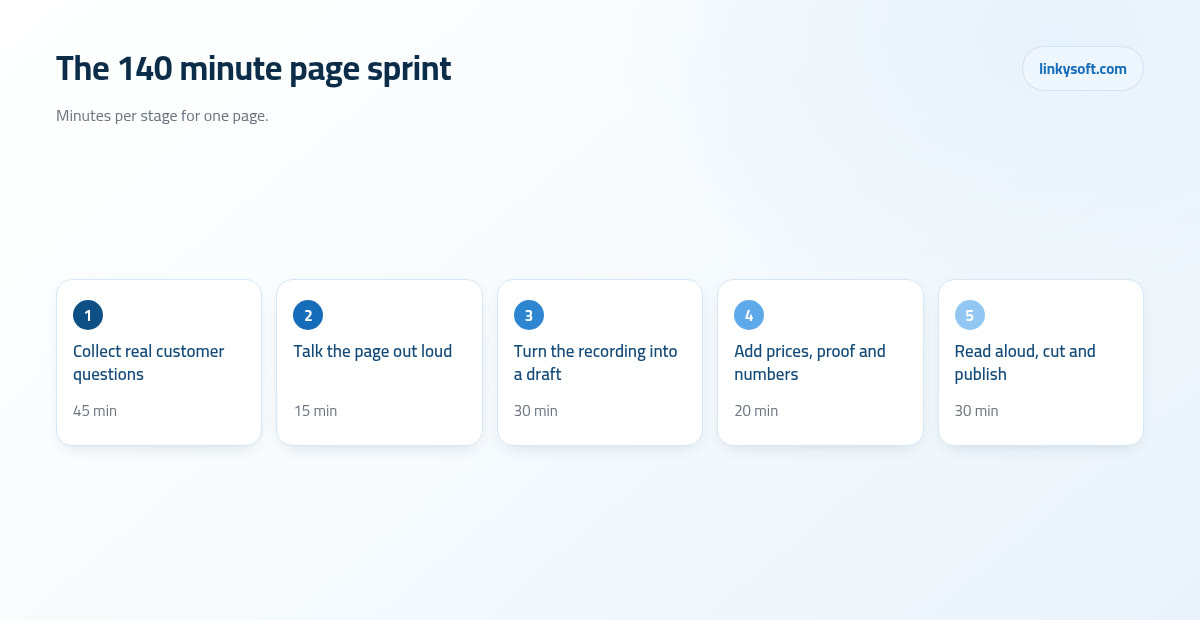
Let us do the money arithmetic straight, because it is the part most guides leave out. A professional copywriter typically charges the equivalent of 80 to 250 US dollars per page, with a strategic home page usually sitting at the top of that range, so eight pages at those rates comes to between 640 and 2,000 dollars depending on the market and the writer. Set against that, the method in this article costs time rather than money, and the sum is worth doing properly rather than waving at. You pay the 45 minute harvest once for the whole site, then 95 minutes for each of the first three pages while you are still learning the shape, and nearer an hour each for the five that follow, which is 630 minutes in total, or ten and a half hours. Assume you get no quicker at all and it is 45 minutes plus eight lots of 95, so 805 minutes, a little under thirteen and a half hours. Ten to thirteen and a half hours of your own time is the honest range.
That turns it into a decision you can make at your own kitchen table. If an hour of your working time is worth more than about 60 to 100 dollars, then buy the two or three pages that carry the money, usually your main service page and the home page, and write the rest yourself using the same skeleton. If your hour is worth less than that, or if the quiet season has arrived and the time is there anyway, writing all of it yourself is simply the better trade.
It is also fair to say plainly when the cheaper option is the right one. A five page site for a local trade, a single clinic or a small shop rarely needs a paid writer, because the owner's own plain description of the work is usually better than anything an outsider could produce from a briefing call. A regulated business, a technical product, or a site selling across several markets and languages usually does need one, since the cost of a wrong sentence there is far higher than the writer's fee.
The middle path is the one we see work most often, and it is much cheaper than either extreme: the owner records and drafts, and a professional edits. You keep your voice and your facts, they fix the structure, tighten the sentences and remove the repetition, and it typically costs a fraction of full copywriting because the hard research has already been done by the person who knew it all along.
Whatever route you take, keeping the site current is cheap as long as it is regular. Thirty to sixty minutes a month, reviewing one page at a time, keeps an eight page site accurate, and one genuinely useful article a month beats twelve published in January and silence for the rest of the year.
Linkysoft spends a good part of every website project helping owners get the words finished so the build can actually ship, because a site that is late by three months has already cost more than any copywriting fee would have. When a client sends us a rough draft, Linkysoft edits it rather than rewriting it, since the owner's own version of a sentence is almost always the more persuasive one. If you would like a hand with the structure, or a second opinion on pages you have already drafted, you are welcome to get in touch, and there is more of this kind of practical material on our blog. Everything above works perfectly well without us, though, which is rather the point: you already have the material, and now you have the shape to pour it into.