Search

Results for records

71 articles

How Much Does a Clinic Management System Cost?

There is no single answer, and any vendor who gives you one before asking about your clinic is guessing. Five things set the number: how many people log in, how much history has to move, what the system must connect to, who runs the servers, and how long you commit for. Here is how each one moves the total, which charges land between signing and go live, what the three charging models are really pricing, and how to put two very different quotes onto one comparable sheet.

1 minute read

How to Write Content for Your Website When You Are Not a Writer

Missing text, not design, is what usually holds a website up. This guide skips the vague advice and hands over the working parts: where to find the words you already own in your own inbox, the order to write your pages in, how long each one should be, a five block skeleton that turns a blank screen into a draft, a recording method that gets a page drafted in about an hour and a half once the questions are collected, and the arithmetic of when to pay a writer instead.

1 minute read

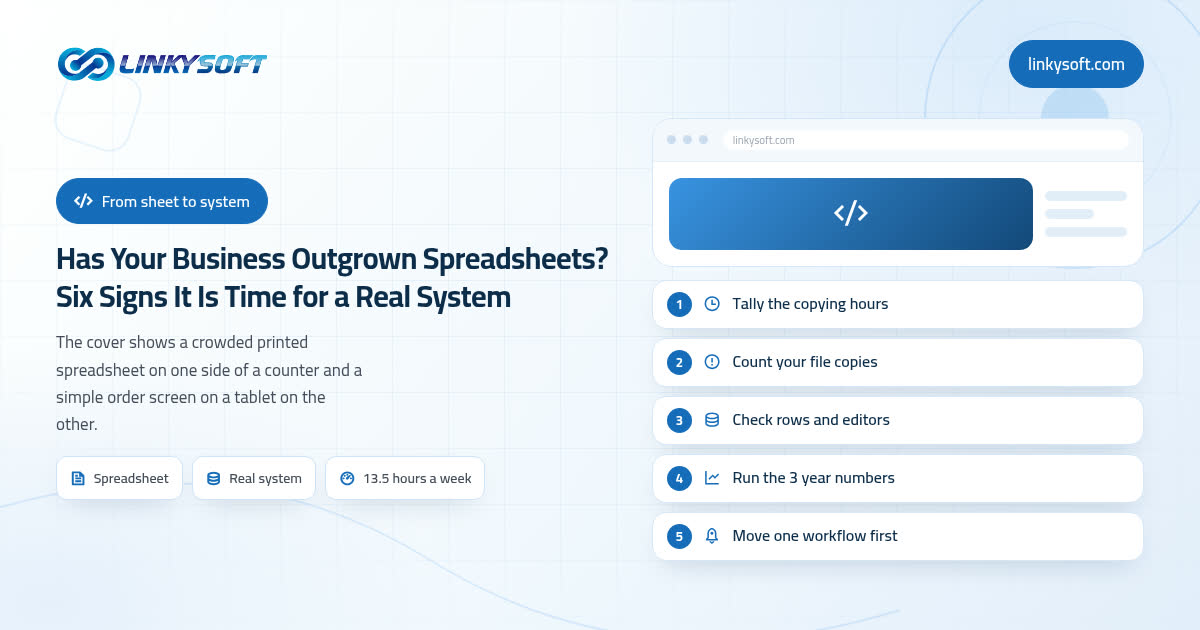
Has Your Business Outgrown Spreadsheets? Six Signs It Is Time for a Real System

Most articles on this subject list a few vague symptoms and then sell you a build. This one hands you the arithmetic instead: what your spreadsheet really costs per week in hours and money, the row counts and editor numbers where a file genuinely stops coping, a three year comparison you can check on a calculator, and the honest conditions under which we tell a client to keep the sheet and spend the money somewhere better.

1 minute read

Lists and Collections in Python

Python is a high-level programming language renowned for its simplicity and versatility. One of its core strengths lies in its ability to handle different data structures, such as lists and collections. Understanding how to work with these data structures effectively is essential for writing efficient and scalable Python programs. In this in-depth guide, we’ll dive into the world of lists and collections in Python, exploring their uses, characteristics, and how they can simplify your

1 minute read

Data Processing and Weak Processing in Python

In the era of big data, data processing has become one of the most important skills in various fields such as finance, healthcare, e-commerce, and marketing. Data processing involves collecting, cleaning, transforming, and analyzing data to extract useful insights that can drive better decision-making. Python has emerged as the go-to language for data processing because of its simplicity, versatility, and an extensive collection of libraries specifically built for data manipulation and analysis.

1 minute read

Uses of Artificial Intelligence in Healthcare

In recent years, artificial intelligence (AI) has emerged as one of the most revolutionary advancements in various industries, with healthcare being at the forefront. AI in healthcare presents a transformative potential that spans across diagnostics, treatment, hospital management, and even patient care. The keyword "artificial intelligence in healthcare" reflects the deep integration of technology in the medical field to improve the quality of care, optimize processes, and ensure better

1 minute read

The Role of Artificial Intelligence in Fraud Detection and Prevention

In an era marked by rapid technological advancements, fraud has become a pressing challenge for both organizations and individuals. With the increasing sophistication of fraudulent activities, traditional methods of fraud detection are no longer sufficient. Artificial intelligence (AI), with its ability to analyze vast amounts of data, recognize patterns, and detect anomalies in real time, has emerged as a powerful tool to counter this growing threat. In this comprehensive article, we will

1 minute read

The Future of Artificial Intelligence and Its Impact on Our Lives

Artificial Intelligence (AI) has evolved from a futuristic concept to a present reality that is shaping almost every aspect of modern life. AI’s influence extends beyond technological innovations, reaching into healthcare, education, transportation, finance, and even our personal lives. In many ways, AI has become an integral part of the digital age, transforming industries, enhancing efficiency, and changing the way we live, work, and interact with each other. As AI continues to develop, its

1 minute read

Machine Learning in Medicine

In the ever-evolving world of healthcare, technology plays a critical role in enhancing patient outcomes, streamlining medical processes, and making healthcare more accessible to everyone. At the forefront of this technological revolution is machine learning (ML), a branch of artificial intelligence (AI) that is rapidly transforming the way medical practitioners diagnose diseases, treat patients, and manage health records. Machine learning in medicine represents a powerful tool that uses

1 minute read

Machine Learning

Machine Learning (ML) is an exciting and transformative technology that is reshaping industries, improving efficiencies, and bringing about unprecedented innovations. As a core component of Artificial Intelligence (AI), ML has the potential to learn from data, identify patterns, and make decisions with minimal human intervention. This guide provides an in-depth look at the essential aspects of machine learning, from its foundational concepts to the advanced techniques that are driving its

1 minute read

How Is Artificial Intelligence Used in Translation and Languages?

Artificial Intelligence (AI) is revolutionizing many industries, and translation is no exception. In the field of translation and linguistics, AI has introduced new opportunities for improving both the speed and accuracy of language translations. AI translation systems, such as Neural Machine Translation (NMT), are transforming the way we approach language barriers, making it easier to communicate across different languages and cultures. This article delves deep into the applications of AI in

1 minute read

History of Artificial Intelligence

The history of artificial intelligence (AI) is a fascinating journey that intertwines technology, philosophy, and ethics. AI has evolved from its early conceptual roots to become a critical part of modern technological advancements. From basic algorithms to advanced machine learning systems, AI has revolutionized industries, enhanced human decision-making, and even raised profound societal questions. In this comprehensive article, we will explore the development of AI, major milestones

1 minute read