Blog

Web Application Development

From choosing a stack to running at scale: how custom web applications are scoped, built, launched, and kept alive long after handover.

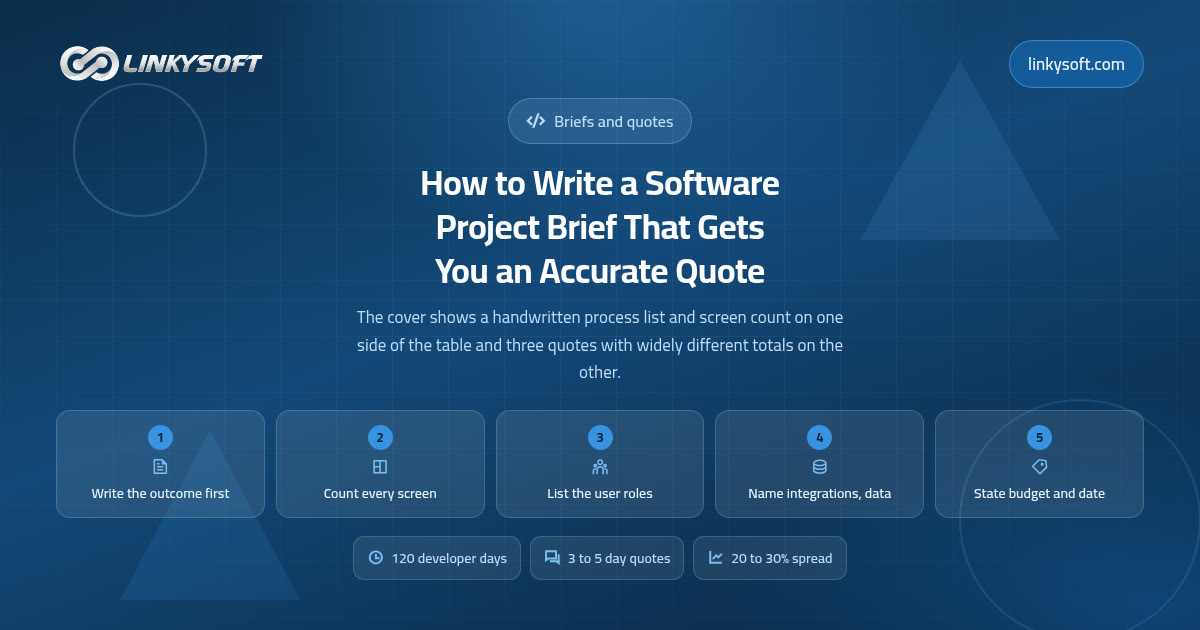
How to Write a Software Project Brief That Gets You an Accurate Quote

Most guides hand you a list of headings and wish you luck. This one shows you how each sentence you write turns into developer days and money: the screen rates we estimate with, what a second user role really costs, why one line about an integration can outweigh a month of work, and the arithmetic that lets you price your own project to within about 30 percent before anybody quotes you.

1 minute read
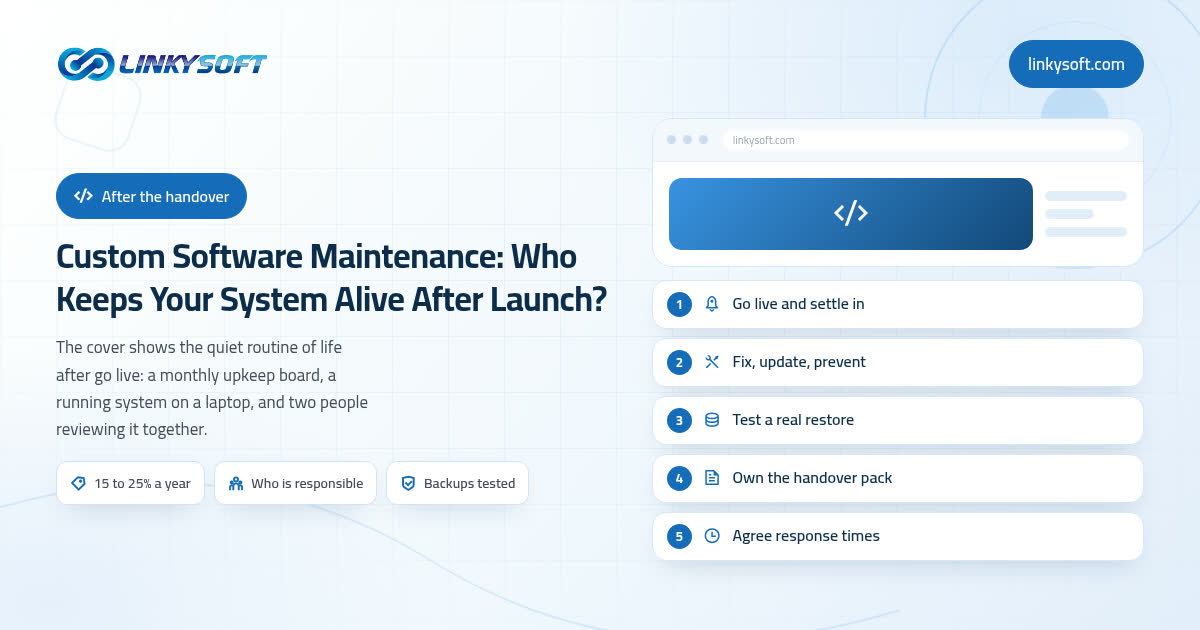
Custom Software Maintenance: Who Keeps Your System Alive After Launch?

Most articles on this subject stop at "buy a maintenance plan". This one walks through the real twelve months after handover with the hours and the money written out: how noisy the first month is, the four kinds of work that never stop, what a year of care actually costs, and the four honest ways of owning it. It also says plainly where we tell a client to buy less support than we would happily sell them.

1 minute read

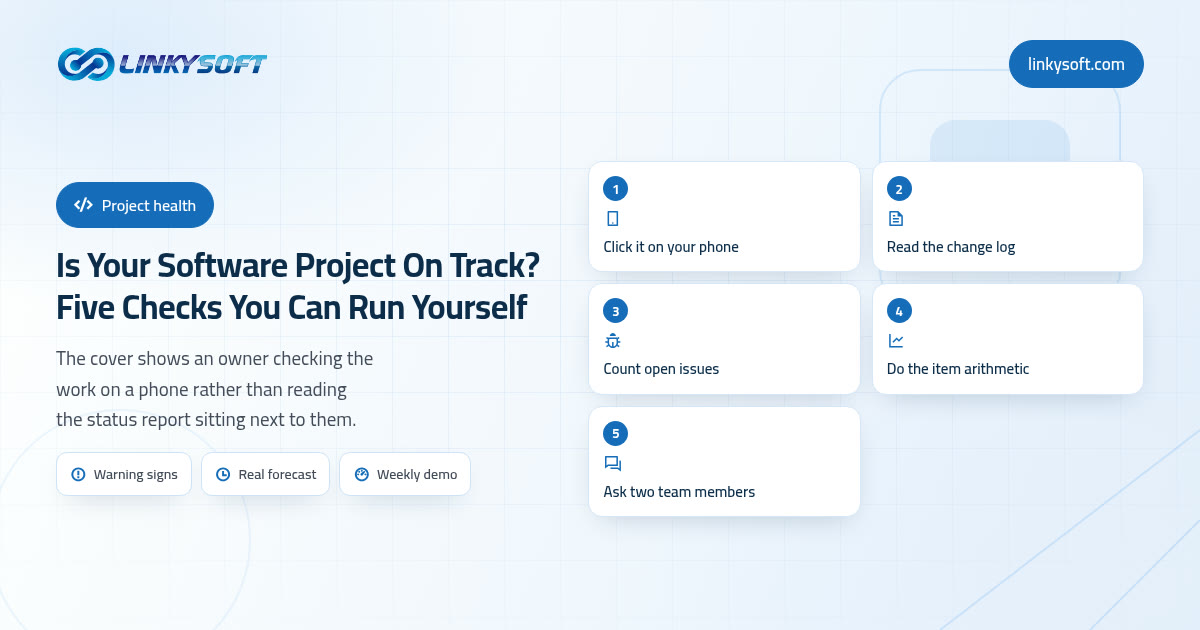
Is Your Software Project On Track? Five Checks You Can Run Yourself

Your update has said eighty percent for three months and you have no way to test whether that is true. This article gives you five checks you can run in an afternoon with no technical knowledge, the simple arithmetic that turns finished work into an honest launch date, the real split of effort hiding behind the screens, and the four levers left when you discover you are behind, including the point where stopping is the right answer.

1 minute read

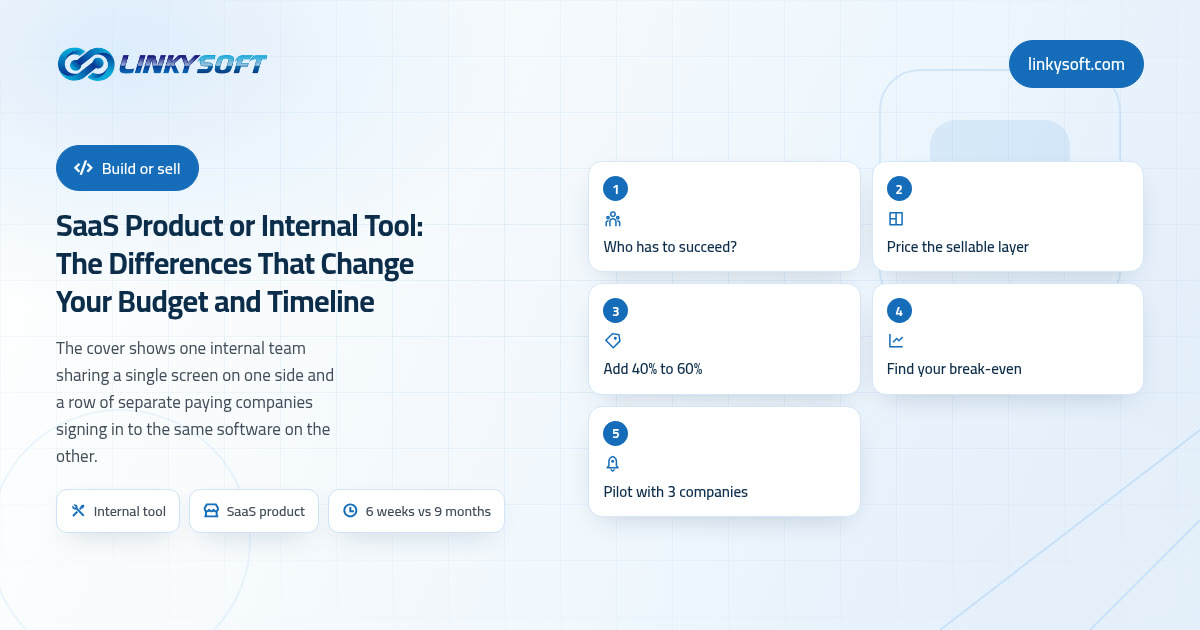
SaaS Product or Internal Tool: The Differences That Change Your Budget and Timeline

Most comparisons of these two paths stop at a feature list, so this one hands you the arithmetic we actually run with clients instead: what the sellable layer adds on top of the very same screens, what each path costs to run every month, how many paying customers it takes to break even, and the honest cases where buying something ready-made, or simply keeping the tool internal, is the smarter purchase.

1 minute read

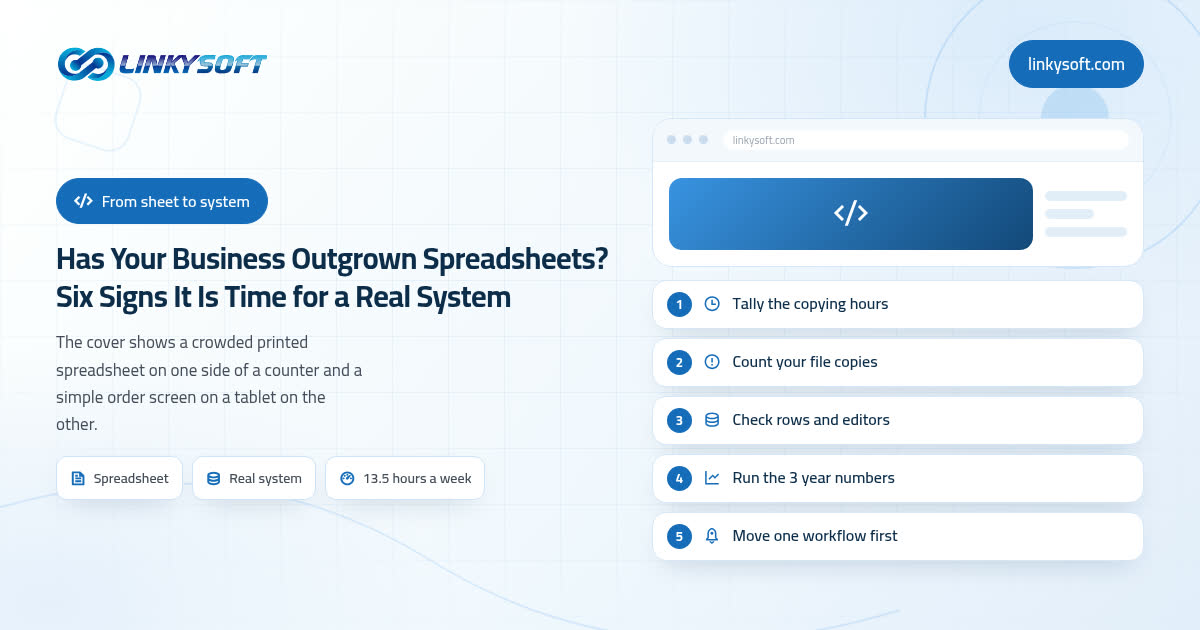
Has Your Business Outgrown Spreadsheets? Six Signs It Is Time for a Real System

Most articles on this subject list a few vague symptoms and then sell you a build. This one hands you the arithmetic instead: what your spreadsheet really costs per week in hours and money, the row counts and editor numbers where a file genuinely stops coping, a three year comparison you can check on a calculator, and the honest conditions under which we tell a client to keep the sheet and spend the money somewhere better.

1 minute read

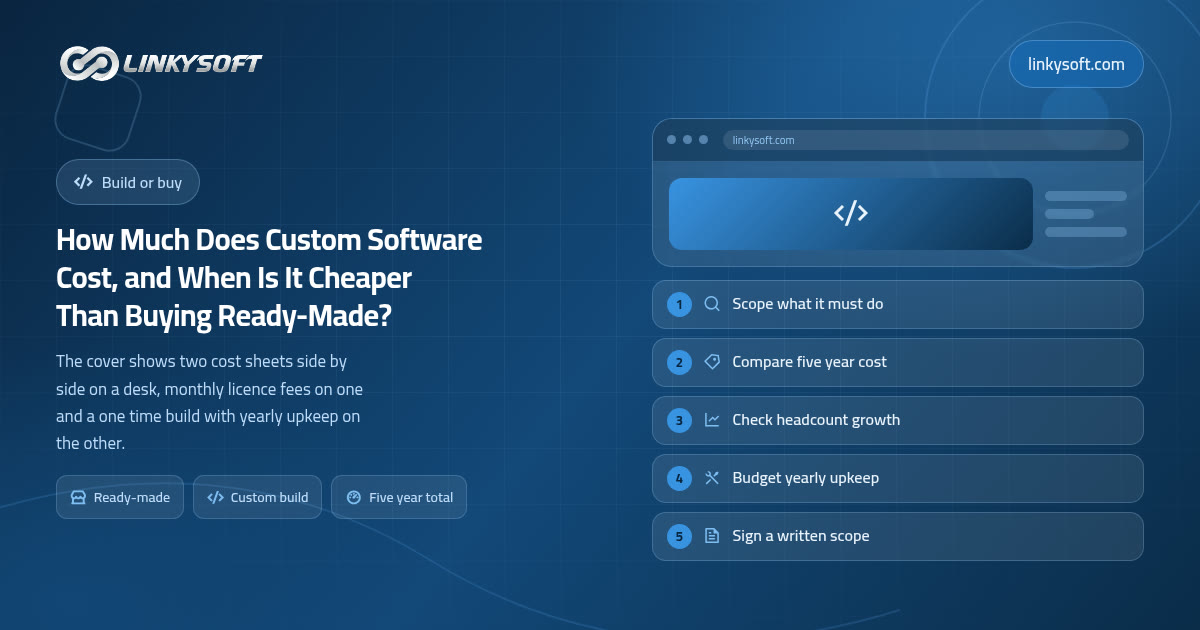
How Much Does Custom Software Cost, and When Is It Cheaper Than Buying Ready-Made?

Most guides to this question give a vague range and stop. This one hands you the whole calculation: the price bands we quote in practice, where the money goes inside a build, the yearly bill that arrives after launch, and the five year totals for renting against building set side by side at 40 users and at 80. It also names the cases where we tell a client to buy something ready-made instead.

1 minute read

Questions about this topic

Quick, clear answers to what readers ask most about this topic.

What is a custom web application?

A custom web application is a private system built for one business and opened from a browser, with nothing to install on each computer. A custom web application keeps customers, orders, stock, staff and money in one place and follows the exact way that business works. Staff can sign in from the office, from home or from a phone.

What is the difference between a website and a web application?

A website mainly shows information to visitors, while a web application lets signed-in users do work, such as entering orders, managing stock or approving requests. A website tells people you exist, and a web application runs the daily work behind it. Many businesses have both, with the website linking to the application's login.

When should a business choose custom software over ready-made software?

A business should choose custom software when ready-made software forces it to change how it works, needs many workarounds or cannot connect to its other systems. Ready-made software is faster to start and fits common needs well. Custom software fits unusual processes, gives the business the source code and grows with it.

How long does it take to build a custom web application?

Building a custom web application takes from a few weeks for a focused system to many months for a large platform. The time depends on the number of features, user roles, integrations and how quickly decisions are made. Building in small stages lets the first part go live early while the rest follows.

What are the main stages of custom web application development?

The main stages of custom web application development are discovery, specification, design, building, testing, launch and ongoing support. Discovery studies the problem and goals, and the specification fixes what will be built before any code is written. Building in visible stages lets the client review the work as it grows.

What is a tech stack in web application development?

A tech stack in web application development is the set of languages, frameworks, databases and servers used to build and run the application. A common stack pairs a backend such as PHP with Laravel, a database such as MySQL and a frontend such as Vue or React. Choosing proven, widely used parts makes the system easier to support for years.

How do I choose the right tech stack for a web application?

You choose the right tech stack for a web application by looking at the project's needs, the size of the community behind each tool and how easy it will be to hire developers later. Mature tools with long support plans are safer than new trends. The team's own experience with the stack also matters a great deal.

What should a software requirements specification include?

A software requirements specification should include the goals of the system, the user roles, every feature described in plain words, the data to be stored, the integrations and the rules for security and performance. A good specification also lists what is out of scope. It gives both sides one shared picture before any code is written.

What is an MVP in software development?

An MVP, or minimum viable product, is the smallest version of a product that still solves the main problem for real users. An MVP is launched early to learn what users actually need before money and time go into extra features. The feedback then guides the next stages of the build.

Who owns the source code of a custom web application?

Who owns the source code of a custom web application depends on the contract, so the ownership terms should be written down before work starts. The client should ideally own the source code and the data, so it can change supplier or hire its own team later. Linkysoft hands the source code, the data and the system to the client, with no lock-in.

What is the difference between a SaaS product and a custom web application?

A SaaS product is ready-made software that many businesses rent and share, while a custom web application is built for one business and owned by it. SaaS starts quickly and the vendor handles updates. A custom web application fits the business exactly and keeps its data under the business's own control.

How is a custom web application kept secure?

A custom web application is kept secure with encrypted connections and storage, access limited by each user's role, two-step login and defense against the OWASP Top 10, the most common web attacks. A record of sensitive actions, tested backups and regular updates close the remaining gaps. Penetration testing, a safe simulated attack, checks the system before launch.

What is multi-tenancy in a web application?

Multi-tenancy in a web application means one system serves many separate customers, called tenants, while keeping each tenant's data apart. Some designs give every tenant its own database, while others share one database with a tenant column on every table. Multi-tenancy is the usual design for SaaS products.

How does a custom web application connect to other systems?

A custom web application connects to other systems through APIs, the secure bridges that let two systems exchange data. Typical connections include payment gateways, e-invoicing, accounting, shipping, WhatsApp, email and SMS. Webhooks let the other system send updates the moment something changes.

Can a web application work on phones as well as computers?

A web application can work on phones as well as computers when it is built with a responsive layout that adapts to each screen size. Staff then open the same system in the phone's browser with no separate install. A progressive web app can also be added to the home screen and work partly offline.

How do you plan a web application to scale as the business grows?

You plan a web application to scale by designing a clean database with indexes, caching frequent reads and moving slow tasks to background queues. Keeping the application servers stateless lets you add more servers behind a load balancer when traffic grows. Measuring real usage shows where the next limit will appear.

What happens after a custom web application is launched?

After a custom web application is launched, it needs hosting, monitoring, backups, security updates, bug fixes and new features as the business changes. Most teams agree a support contract that sets response times and what is covered. Software that nobody looks after slowly becomes slow and unsafe.

What is technical debt in software development?

Technical debt in software development is the extra work created when code is written the quick way instead of the right way. Like a loan, technical debt grows over time, making each new feature slower and riskier to add. Regular clean-up and code review keep the debt under control.

Why do software projects go over time?

Software projects go over time mostly because the requirements were unclear, the scope kept growing or decisions came late. Underestimating integrations and testing is another common cause. A clear written specification, small stages and regular reviews keep a project on its timeline.

How do I choose a software development company?

You choose a software development company by looking at its past projects, how long it has worked, how it explains its process and who will own the code. Ask how it handles security, testing, hosting and support after launch. A good company asks many questions about your business before talking about technology.

What is the difference between fixed-scope and time-based software contracts?

A fixed-scope software contract agrees a set list of features and a timeline up front, while a time-based contract pays for the hours actually worked. Fixed scope gives certainty when the requirements are clear. Time-based work suits projects that will change a lot as they go.

How do I move data from an old system into a new web application?

You move data from an old system into a new web application by mapping every old field to the new structure, cleaning the data and running test imports before the final move. Users then check the imported records against the old system. A planned cut-over date and a fallback plan keep the business running during the switch.

Can a custom web application work in Arabic and English?

A custom web application can work in Arabic and English when it is built with translation files and right-to-left support from the start. The layout then flips correctly for Arabic, and each user picks a language. Adding a language later is much harder than planning for it early.

What is user acceptance testing in web application development?

User acceptance testing in web application development is the stage where real users work through real tasks in the system before launch. User acceptance testing checks that the software does what the business needs, not only that the code runs. Problems found at this stage are cheaper to fix than after go-live.

Why do businesses replace spreadsheets with a web application?

Businesses replace spreadsheets with a web application because spreadsheets break down when several people edit them, data is typed twice and nobody knows which copy is correct. A web application keeps one database, controls who can see and change each record and keeps a history. Reports then update on their own instead of being built by hand.